Tax Calculator for Salary: How Income Tax, NI & FICA Are Actually Calculated (2026)

Quick answer: A tax calculator for salary works out Income Tax and National Insurance (UK) or Federal Income Tax and FICA (US) on your gross pay, using the current tax year’s bands, allowances, and thresholds. But the standard calculation is only the starting point — your tax code, whether you’re employed or self-employed, a second job, or a bonus can all change the result. This guide explains exactly how a tax calculator works under the hood, and covers the situations a basic calculator often gets wrong.
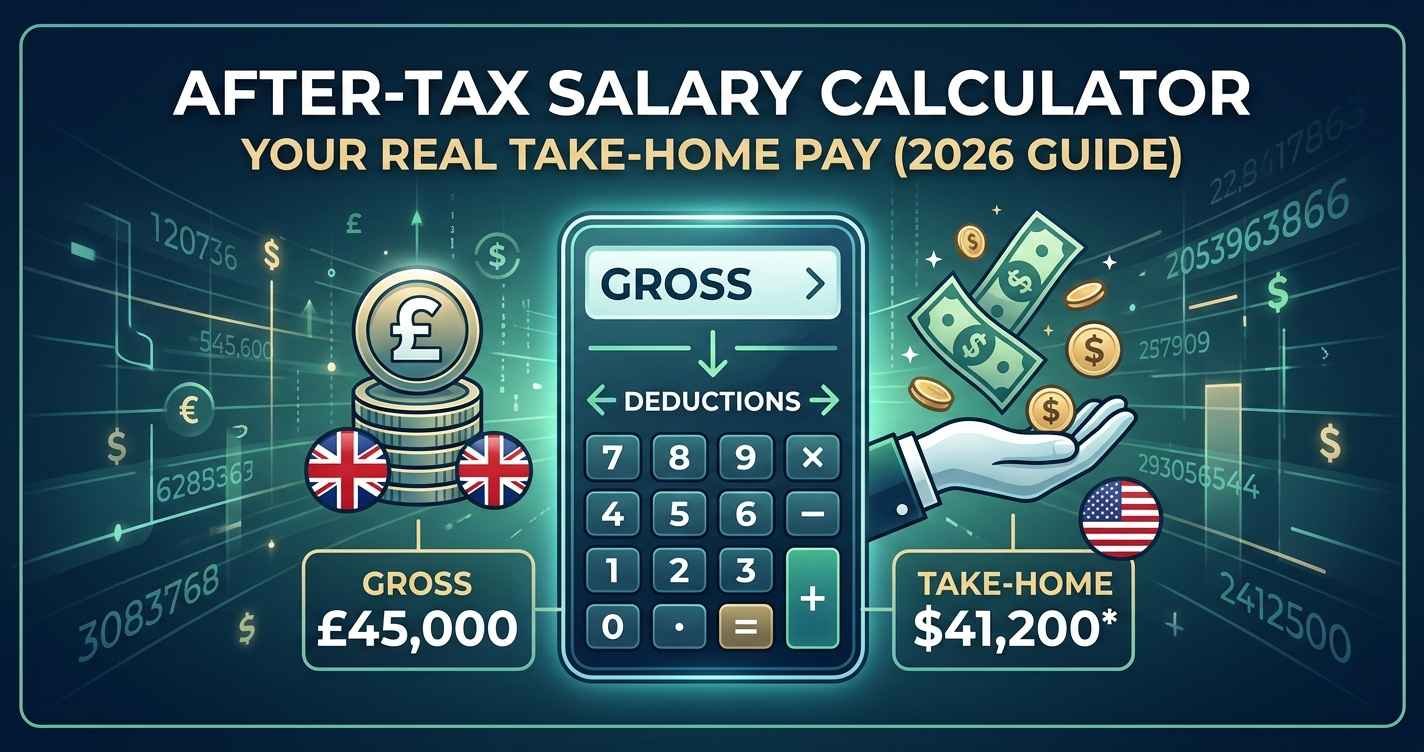
For the standard employee calculation and worked examples, see our after-tax salary calculator guide, and for gross salary formulas, see how to calculate salary. You can also use the free tax calculator directly.
How a Tax Calculator for Salary Actually Works
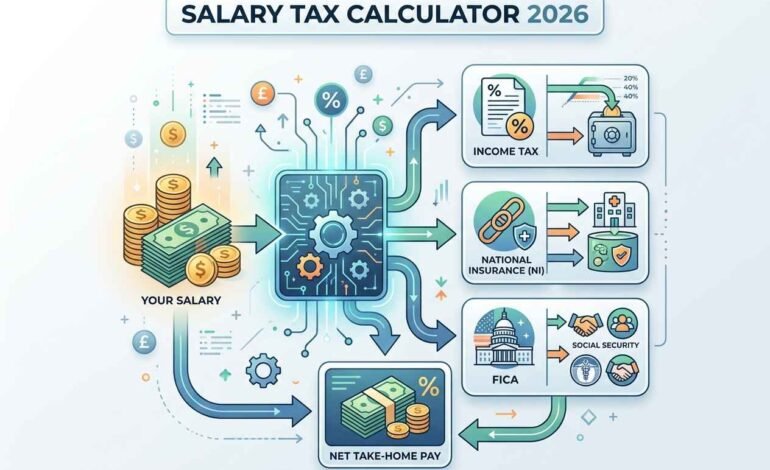
Behind the scenes, every salary tax calculator follows the same sequence of steps:
- Start with gross salary. If paid hourly, this is hours × rate × pay periods first.
- Subtract the tax-free allowance. UK: the £12,570 Personal Allowance (adjusted for your tax code). US: the standard deduction, based on filing status.
- Apply tax bands to what remains, in order. Each band is taxed only on the portion of income that falls within it — this is called marginal or progressive taxation.
- Add National Insurance or FICA separately. These use their own thresholds and aren’t affected by your income tax allowance.
- Subtract any other known deductions (student loans, pension contributions) if the calculator supports them.
- Return gross salary minus all of the above as the after-tax result.
A calculator that skips step 5, or uses a generic tax code instead of yours, will be close but not exact — which is why the sections below cover the situations that commonly cause a mismatch.
UK Tax Codes Explained: Why Your Tax Calculator Result Might Differ
A standard salary tax calculator assumes the most common tax code, 1257L (Personal Allowance of £12,570, applied cumulatively across the tax year). If your actual tax code is different, your real deduction will differ from the calculator’s default:
| Tax code | What it means |
|---|---|
| 1257L | Standard code — full £12,570 Personal Allowance, most common code |
| BR | Basic Rate on all income, no Personal Allowance — common on a second job |
| D0 | Higher Rate (40%) on all income — used when a second job’s income is entirely within the higher band |
| D1 | Additional Rate (45%) on all income |
| K-prefix (e.g. K475) | Negative allowance — used when untaxed income or benefits exceed your allowance, adding extra tax rather than reducing it |
| 0T | No Personal Allowance applied, taxed using standard bands from zero — often used when HMRC lacks enough information |
| W1 / M1 (emergency tax) | Non-cumulative — each pay period is taxed in isolation rather than against a running total for the year, often used temporarily after a job change |
If your tax calculator result doesn’t match your payslip, checking your tax code against the list above is usually the fastest way to find out why — you can find yours on a recent payslip or your GOV.UK Personal Tax Account.
US: Withholding vs Actual Tax Owed
In the US, a salary tax calculator estimates your actual annual tax liability — but the amount withheld from each paycheck is a separate estimate, controlled by the elections on your Form W-4. These two numbers rarely match exactly, which is why most people either get a refund or owe money when they file:
- Withholding > actual tax owed — you overpaid throughout the year and receive a refund when you file.
- Withholding < actual tax owed — you underpaid and owe the difference (plus possible penalties if the shortfall is large) when you file.
A salary tax calculator that shows your “after-tax salary” is estimating your actual tax liability spread evenly across the year — it isn’t necessarily what your paycheck withholding will show, especially if your W-4 claims extra withholding, dependents, or additional income adjustments. Details on completing a W-4 accurately are on the IRS Tax Withholding Estimator page.
Self-Employed Tax Calculator: How It’s Different
A tax calculator for a self-employed person works differently to one for an employee, because self-employment tax uses profit (income minus allowable business expenses), not gross pay, and adds different social insurance contributions.
UK: Income Tax + Class 4 National Insurance
Self-employed people pay Income Tax on profits using the same bands as employees, plus Class 4 National Insurance at 6% on profits between £12,570 and £50,270, and 2% above that (2026/27 rates, per GOV.UK). Mandatory Class 2 NI was abolished from April 2024; a voluntary Class 2 payment of £3.65/week is available to protect State Pension entitlement if profits are low. Both are calculated and paid through Self Assessment, not deducted from a payslip.
Worked example: £40,000 profit
- Income Tax: (£40,000 − £12,570) × 20% = £5,486
- Class 4 NI: (£40,000 − £12,570) × 6% = £1,645.80
- Take-home: £40,000 − £5,486 − £1,645.80 = £32,868.20
US: Federal Income Tax + Self-Employment Tax
Self-employed Americans pay Self-Employment Tax of 15.3% (12.4% Social Security + 2.9% Medicare) on 92.35% of net self-employment earnings, per IRS guidance, in addition to federal income tax. Half of the Self-Employment Tax is deductible from taxable income.
Worked example: $50,000 net self-employment earnings, single filer
- Self-Employment Tax base: $50,000 × 92.35% = $46,175
- Self-Employment Tax: $46,175 × 15.3% = $7,064.78
- Half of SE tax deductible: $3,532.39
- Taxable income: $50,000 − $3,532.39 − $16,100 (standard deduction) = $30,367.61
- Federal income tax (approx.): $3,396.11
- Approximate take-home: $50,000 − $7,064.78 − $3,396.11 = $39,539.11 (before any state tax)
Second Job or Multiple Income Sources: How Tax Calculators Handle It
A basic tax calculator usually assumes one income source and applies your full tax-free allowance to it. If you have a second job or multiple income sources, this assumption breaks down:
- UK: Your Personal Allowance is normally given entirely to your main job’s tax code (1257L), while a second job is usually taxed at Basic Rate (BR) from the very first pound, with no allowance — since the allowance has already been used against job one. If your combined income is high enough, HMRC may instead issue a D0 code on the second job.
- US: All income (from one or more W-2 jobs, plus 1099 self-employment income) is combined on a single tax return, and the tax bands apply to the combined total — so a second job’s income is effectively taxed starting at whatever marginal rate your first job’s income already reached, not from the bottom bracket again.
This is why running each job through a standard tax calculator separately, as if each had its own fresh allowance, usually understates your true combined tax bill.
Why Bonus and Overtime Tax Looks Higher Than Expected
A common misconception is that bonuses or overtime are taxed at a special, higher rate. They aren’t — they’re taxed using the same bands as regular income. What actually happens is usually one of these:
- UK cumulative tax: If a bonus is paid in the same period as your regular salary, payroll software calculates tax on the combined amount for that period, which can temporarily push part of it into a higher band — the excess is corrected later in the tax year as your total income evens out.
- US supplemental wage withholding: The IRS allows employers to withhold a flat 22% on supplemental wages like bonuses (for amounts up to $1 million), separate from your regular paycheck’s withholding calculation — this is often higher than your actual marginal rate, so it can feel like the bonus was taxed more heavily, even though your year-end tax liability is based on your total income, not this withholding rate.
In both cases, the higher-looking deduction on a bonus or overtime payment is usually a withholding/calculation quirk, not a genuinely higher permanent tax rate on that income.
Can Overtime or a Bonus Push You Into a Higher Tax Bracket?
Yes, but only the portion of income above the threshold is taxed at the higher rate — your whole salary doesn’t suddenly get taxed at the top rate. For example, a UK employee earning £49,000 who takes on £3,000 of overtime moves to £52,000 total income. Only the £1,730 above the £50,270 higher-rate threshold is taxed at 40%; the rest stays at 20%. This is exactly what “marginal rate” means, and it’s why a small amount of extra income rarely makes someone financially worse off overall, even when it crosses into a new band.
The one UK exception worth knowing: between £100,000 and £125,140, the Personal Allowance tapers away at the same time as the 40% rate applies, creating an effective marginal rate of 60% in that specific band — genuinely the one range where extra income is taxed unusually heavily.
Tax Calculator Cheat Sheet (2026/2026-27)
| Situation | What changes vs a standard calculator |
|---|---|
| Standard employee, one job | Standard calculation applies directly |
| Second job (UK) | Usually BR code, no Personal Allowance on that job |
| Second job (US) | Combined income taxed together on one return |
| Self-employed (UK) | Add Class 4 NI (6%/2%) on profit, not Class 1 |
| Self-employed (US) | Add 15.3% Self-Employment Tax instead of standard FICA |
| Bonus (UK) | May look higher-taxed short-term; corrects over the tax year |
| Bonus (US) | Often withheld at a flat 22%; reconciled at filing |
| Income £100k–£125,140 (UK) | Effective 60% marginal rate due to allowance taper |
How to Choose a Reliable Salary Tax Calculator
Not all salary tax calculators are built the same. When picking one, check that it:
- Uses the current tax year’s rates — UK Personal Allowance, National Insurance thresholds, and US federal brackets and the Social Security wage base all change most years.
- Separates Income Tax from National Insurance/FICA — a calculator that only shows income tax will understate your real deduction.
- Lets you specify filing status (US) or select the right nation (UK) — Single vs Married Filing Jointly, or Scotland vs rest-of-UK, materially change the result.
- States its assumptions clearly — whether it includes state tax, student loans, or pension contributions, so you know exactly what the figure does and doesn’t cover.
Our free overtime and take-home pay calculator covers all of the above for standard UK and US employee income, including overtime.
Tax Calculator Glossary
- Marginal tax rate: The tax rate on your next pound or dollar of income, not your average rate across your whole salary.
- Effective tax rate: Total tax paid divided by total gross income — always lower than your top marginal rate.
- Tax code (UK): A short code telling your employer how much tax-free allowance to apply to your pay.
- Withholding (US): Tax your employer sends to the IRS on your behalf throughout the year, based on your W-4.
- Self Assessment (UK): The annual tax return process self-employed people (and some employees) use to report income and pay tax directly.
- Self-Employment Tax (US): The 15.3% Social Security + Medicare tax self-employed people pay instead of employer/employee FICA.
Common Tax Calculator Mistakes
- Assuming a generic calculator matches your exact tax code. Most tools default to the standard code — if yours differs, adjust manually or check the calculator supports custom tax codes.
- Treating a bonus as taxed at a special rate. As covered above, it’s usually a withholding quirk, not a genuinely higher permanent rate.
- Forgetting self-employed contributions use profit, not turnover. Only income after allowable business expenses is taxable.
- Running two jobs through a calculator separately. This double-counts your tax-free allowance and understates your real combined tax bill.
- Confusing US withholding with actual tax liability. They’re related but different figures — a calculator showing after-tax salary is estimating liability, not your specific paycheck withholding.
Related Guides
- After-Tax Salary Calculator: How to Work Out Your Real Take-Home Pay — the standard UK/US formula and worked examples.
- Salary After Tax Calculator: Weekly, Monthly & Annual Take-Home Pay — pay-period breakdown and Scotland vs rest-of-UK comparison.
- How to Calculate Salary: Hourly, Daily, Weekly, Monthly & Annual — gross salary formulas, pro-rata, and pay rises.
- Free Overtime, Hourly-to-Salary and Take-Home Pay Calculator — run your own numbers.
Frequently Asked Questions
Why doesn’t a tax calculator match my payslip exactly?
Usually because of your specific tax code, pre-tax deductions like pension contributions, mid-year pay changes, or (in the US) your W-4 withholding elections — a standard calculator uses default assumptions that may not match your exact circumstances.
Is a bonus taxed differently from regular salary?
No, not permanently. Bonuses use the same tax bands as regular income, though payroll withholding calculations (cumulative tax in the UK, flat supplemental withholding in the US) can make a single payment look more heavily taxed than your actual annual liability.
How is tax calculated for a second job in the UK?
Your Personal Allowance is normally applied entirely to your main job. A second job is usually taxed at Basic Rate (BR) with no allowance, or Higher Rate (D0) if your combined income is high enough.
Do self-employed people pay the same tax as employees?
They pay Income Tax using the same bands, but National Insurance/Social Security works differently: UK self-employed pay Class 4 NI on profits (no employer NI or Class 1), and US self-employed pay Self-Employment Tax (15.3%) instead of standard FICA.
Why do I owe tax (or get a refund) when I file my US tax return?
Because your employer’s withholding, based on your W-4, is only an estimate of your actual tax liability. If too much was withheld, you get a refund; if too little was withheld, you owe the difference.
What does my UK tax code mean?
The number shows your tax-free allowance (1257 means £12,570), and the letter indicates the type of code — L for standard, BR/D0/D1 for flat-rate codes often used on second jobs, and K for a negative allowance.
Can a tax calculator work out Class 4 National Insurance for me?
Yes, if it’s designed for self-employed income — it should apply the 6%/2% Class 4 rates to your profit figure, separately from Income Tax, rather than using the employee Class 1 NI rates.
Does overtime always push me into a higher tax bracket?
Only if your total income for the year crosses a band threshold, and even then only the portion above that threshold is taxed at the higher rate — not your entire income.
Why is the 40%–60% tax range between £100,000 and £125,140 different?
Because the Personal Allowance is being withdrawn at the same time as the 40% Higher Rate applies, creating a combined effective rate of 60% on income in that specific band — the only part of the UK system where this happens.
Does a salary tax calculator account for state income tax in the US?
Not by default in most general calculators, since state tax rates vary widely and some states have none. Check whether the calculator you’re using includes a state tax option, or add it as a separate step.
Key Takeaways
- A standard tax calculator assumes a single job and the default tax code — a second job, self-employment, or an unusual tax code changes the real result.
- Bonuses and overtime aren’t taxed at a special higher rate — only the withholding calculation can make them look that way short-term.
- Self-employed tax uses profit, not turnover, and adds Class 4 NI (UK) or Self-Employment Tax (US) instead of standard employee contributions.
- Use the free tax calculator for a standard-employee estimate, and adjust manually for any of the situations above.
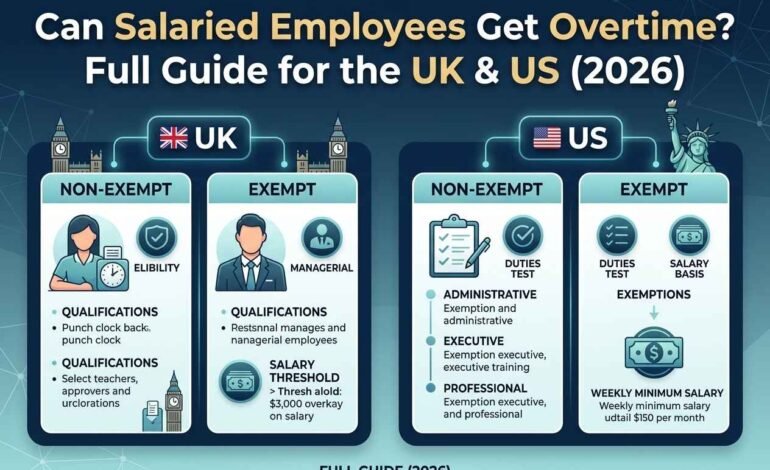
See also: Can Salaried Employees Get Overtime? Full Guide for the UK & US — FLSA exempt/non-exempt rules and the 2026 threshold change, plus UK contract-based overtime rights.
See also: Overtime for Salaried Employees: How It’s Actually Calculated — the standard method vs the Fluctuating Workweek method, with worked examples.
Sources
Figures and rules in this guide are based on GOV.UK (Tax codes), GOV.UK (Self-employed National Insurance rates), the IRS Tax Withholding Estimator, and IRS guidance on Self-Employment Tax. Figures are for guidance only — for advice on your specific tax code or filing situation, consult HMRC, the IRS, or a qualified accountant.