
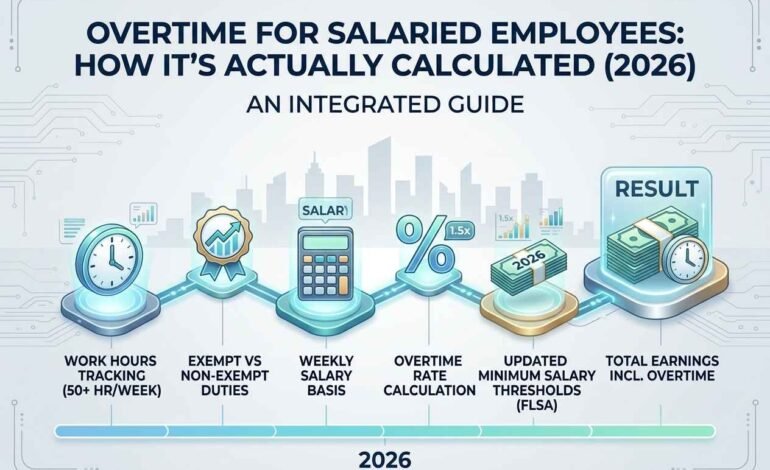
Overtime for Salaried Employees: How It’s Actually Calculated (2026)

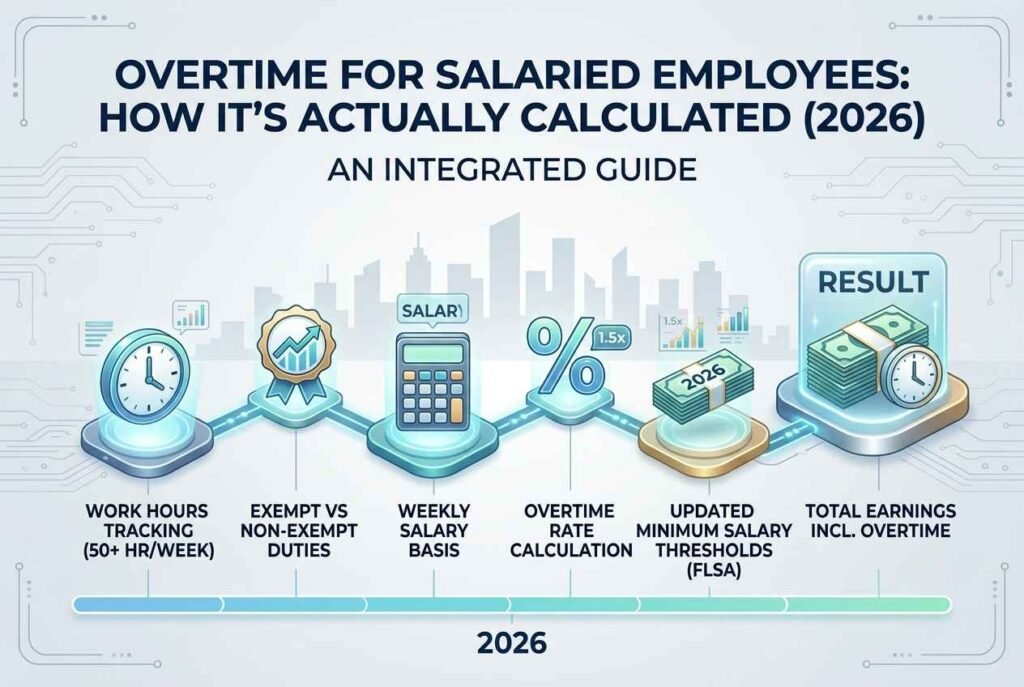
Overtime for salaried employees isn’t calculated the same way as for hourly staff — you first have to convert the fixed salary into a “regular hourly rate,” then apply the correct overtime multiplier. In the US, there are two legally recognized methods (the standard method and the Fluctuating Workweek method) that can produce noticeably different overtime pay for the exact same salary and hours. In the UK, the calculation is simpler but entirely contract-driven.
This guide walks through exactly how overtime for salaried employees is calculated, with worked examples for each method. If you’re first checking whether you’re even entitled to overtime as a salaried employee, see our companion guide: Can Salaried Employees Get Overtime?. Once you know your rate, use the free overtime and take-home pay calculator to see the full after-tax figure.
Step 1: Convert a Salary Into a Regular Hourly Rate (US)
Under the standard method, a salary intended to cover a fixed 40-hour week is converted to an hourly rate by simple division:
Regular rate = Weekly salary ÷ 40
Overtime is then paid at 1.5× that regular rate for each hour over 40:
Total weekly pay = Weekly salary + (Overtime hours × Regular rate × 1.5)
Example: A salaried non-exempt employee earns $800/week for a standard 40-hour week, and works 45 hours one week.
- Regular rate: $800 ÷ 40 = $20/hour
- Overtime pay: 5 hours × $20 × 1.5 = $150
- Total pay for the week: $800 + $150 = $950
The Fluctuating Workweek (FWW) Method: A Different Way to Calculate Salaried Overtime
US federal regulation 29 CFR 778.114 recognizes a second, legally valid way to calculate overtime for salaried non-exempt employees: the Fluctuating Workweek method. It applies when a fixed salary is intended to cover all hours worked in a week, however many that turns out to be, and both employer and employee have a clear mutual understanding of this arrangement.
Because the fixed salary already pays straight-time for every hour worked (not just the first 40), the regular rate is recalculated each week based on actual hours, and only a 0.5× premium — not the full 1.5× — is added for overtime hours, since straight-time pay for those hours is already included in the salary:
Regular rate (FWW) = Weekly salary ÷ Actual hours worked that week
Overtime premium = Overtime hours × Regular rate × 0.5
Example: The same $800/week salary, intended to cover all hours worked, with the employee working 45 hours that week:
- Regular rate: $800 ÷ 45 = $17.78/hour
- Overtime premium: 5 hours × $17.78 × 0.5 = $44.44
- Total pay for the week: $800 + $44.44 = $844.44
Notice the same salary and the same hours produce very different total pay ($950 under the standard method vs $844.44 under FWW) — and the FWW regular rate falls as hours increase, since the fixed salary is divided across more hours. The FWW method has specific legal requirements (a clear mutual understanding, a genuinely fluctuating schedule, and the salary meeting minimum wage for the highest number of hours worked in the period), so it can’t simply be chosen for convenience — see the Department of Labor’s overtime guidance for the full requirements.
Standard Method vs Fluctuating Workweek: Side-by-Side Comparison
| Standard method | Fluctuating Workweek (FWW) method | |
|---|---|---|
| Assumption | Salary covers a fixed 40-hour week | Salary covers all hours worked, whatever they are |
| Regular rate | Salary ÷ 40 (fixed) | Salary ÷ actual hours worked (varies weekly) |
| Overtime multiplier | 1.5× regular rate | 0.5× regular rate (premium only) |
| 45-hour week on $800 salary | $950 total | $844.44 total |
| Requires written agreement? | Not specifically | Yes — clear mutual understanding required |
The FWW method generally produces lower total pay in higher-overtime weeks, and is more commonly used by employers with genuinely unpredictable schedules (such as retail or logistics roles) rather than as a way to minimize cost — using it incorrectly, or without the required agreement, can expose an employer to back-pay liability.
UK: How Overtime Is Calculated for Salaried Staff
UK overtime calculation is more straightforward since it’s governed entirely by the employment contract rather than competing federal methods. The typical approach:
- Find the hourly equivalent: Hourly rate = Annual salary ÷ 52 ÷ Contracted weekly hours.
- Apply the contractual overtime multiplier (commonly 1.0x, 1.5x, or 2x, as set out in the contract or company policy — there’s no statutory default).
- Multiply by overtime hours worked.
Example: A £28,000 salary for a 37.5-hour contracted week, with a contractual 1.5x overtime rate, and 5 hours of overtime worked one week:
- Hourly equivalent: £28,000 ÷ 52 ÷ 37.5 = £14.36
- Overtime pay: 5 × £14.36 × 1.5 = £107.70
- Total pay for the week: (£28,000 ÷ 52) + £107.70 = £538.46 + £107.70 = £646.16
If the contract instead specifies unpaid overtime, the employer only needs to ensure the average hourly rate across all hours worked (including the unpaid overtime) doesn’t fall below the National Minimum Wage — see our guide on whether salaried employees are entitled to overtime for the full legal picture.
Calculating Overtime When Pay Rates Vary Within a Week
Some salaried non-exempt employees earn additional amounts within a week — a shift differential, a non-discretionary bonus, or commission — that must legally be factored into the regular rate used for overtime, not just the base salary. This is done using a blended (weighted average) rate:
Blended regular rate = Total straight-time earnings for the week ÷ Total hours worked
Example: An employee’s $800 base salary for the week, plus a $90 non-discretionary shift bonus, working 45 hours total:
- Total straight-time earnings: $800 + $90 = $890
- Blended regular rate: $890 ÷ 45 = $19.78/hour
- Overtime premium (standard method): 5 × $19.78 × 0.5 = $49.44 (since the $890 already includes straight-time pay for all 45 hours, only the extra 0.5x premium is added)
- Total pay: $890 + $49.44 = $939.44
Discretionary bonuses (true surprise bonuses not tied to hours, performance, or production) generally don’t need to be included in the regular rate calculation — but most bonuses tied to performance or attendance do count, which is a common area employers get wrong.
Common Mistakes When Calculating Salaried Overtime
- Using the FWW method without the required agreement. The 0.5x-only premium is only legally valid where the specific FWW conditions are met — applying it as a default cost-saving shortcut is a compliance risk.
- Leaving non-discretionary bonuses out of the regular rate. Shift differentials, attendance bonuses, and production bonuses generally must be included when calculating the regular rate for overtime purposes.
- Always dividing by 40, even for genuinely fluctuating schedules. Only the standard method divides by a fixed 40 hours — FWW divides by actual hours worked, which changes the regular rate every week.
- Applying a UK contractual overtime rate without checking the actual contract. Since there’s no statutory UK rate, assuming “time and a half” without checking the written terms can lead to underpayment or overpayment.
- Forgetting overtime affects take-home pay differently to gross pay. A gross overtime calculation doesn’t show what actually lands in your account after tax — see our after-tax salary calculator guide for that step.
Weekend, Holiday, and Premium Overtime Rates
Beyond the base overtime calculation, many employers apply higher multipliers for specific circumstances — though whether they’re required to depends entirely on jurisdiction and contract:
- US: The FLSA doesn’t require extra pay for weekend, holiday, or night work on its own — only the standard 1.5x (or FWW 0.5x premium) applies once weekly hours exceed 40, regardless of which days those hours fall on. Any higher weekend or holiday rate is a matter of employer policy, union agreement, or state law, not federal law.
- UK: Similarly, there’s no statutory requirement for a higher weekend or bank holiday overtime rate — but it’s common practice for UK employers to offer enhanced rates (such as double time on a public holiday) as a contractual benefit, particularly in retail, hospitality, and healthcare.
If your contract or company policy specifies a premium rate for certain days or shifts, that rate is calculated the same way as standard overtime — regular/hourly-equivalent rate × the specified multiplier × hours worked under that premium.
Why Overtime Arrangements Should Be in Writing
Whichever method or rate applies, having the arrangement documented in writing protects both employer and employee:
- For employers (US): Using the Fluctuating Workweek method without a documented mutual understanding is one of the most common compliance failures the Department of Labor identifies in overtime audits — a clear written agreement is the strongest evidence the requirement was met.
- For employers (UK): Since there’s no statutory overtime rate, the contract is the only source of the entitlement — an ambiguous or missing overtime clause creates real risk of dispute.
- For employees: A written overtime policy or clause is the clearest way to confirm what rate applies before working extra hours, rather than relying on verbal assurances.
If you’re unsure which calculation method applies to your own pay, your HR or payroll department should be able to confirm it — and for US employees, the arrangement should be explained at the time it’s set up, not discovered after the fact on a payslip.
Part-Time Salaried Employees and Overtime
A part-time salaried employee — for example, someone on a fixed salary for a contracted 25-hour week — can still be entitled to overtime once their hours exceed the relevant threshold. In the US, non-exempt part-time salaried employees are still owed overtime for any hours worked over 40 in a week, calculated the same way as for full-time staff (regular rate = salary ÷ the hours the salary is intended to cover). In the UK, whether hours worked beyond the part-time contracted hours count as paid overtime, or simply as additional straight-time pay up to the equivalent of a full-time week, again comes down to what the contract says — some UK contracts only pay an enhanced overtime rate once hours exceed the standard full-time week, not just the individual’s own part-time hours.
How to Check Your Own Overtime Pay Was Calculated Correctly
- Confirm which method applies to you. Standard, Fluctuating Workweek, or a UK contractual rate — check your offer letter, contract, or ask HR directly.
- Recalculate your regular rate using the correct formula for that method and your actual hours for the pay period in question.
- Check whether any bonuses or shift pay should have been included in the regular rate calculation (US) before the overtime multiplier was applied.
- Compare your recalculated figure to your payslip. A small difference (a few dollars/pounds) is usually rounding; a large difference is worth raising.
- Keep your own hours record as a backup, especially if your schedule fluctuates or overtime is common — this makes any dispute far easier to resolve.
Key Terms Explained
- Regular rate: The hourly rate used as the base for overtime calculations, derived from salary and hours — not necessarily the same as a simple salary-to-hourly conversion.
- Standard method: Divides salary by a fixed 40 hours to find the regular rate; overtime paid at 1.5x that rate.
- Fluctuating Workweek (FWW) method: Divides salary by actual hours worked each week; overtime paid at only a 0.5x premium, since straight-time is already covered.
- Non-discretionary bonus: A bonus tied to hours, performance, attendance, or production — must be included in the regular rate for overtime.
- Discretionary bonus: A genuinely surprise bonus not tied to a formula or expectation — can generally be excluded from the regular rate.
- Contractual overtime rate (UK): The overtime multiplier set out in an employment contract, since UK law sets no statutory rate.
Choosing the Right Calculation: A Quick Decision Guide
- Fixed 40-hour week, US: Use the standard method — salary ÷ 40, then 1.5x for overtime.
- Genuinely fluctuating hours with a documented agreement, US: The Fluctuating Workweek method may apply — salary ÷ actual hours, then 0.5x premium.
- Non-discretionary bonus or shift pay involved, US: Blend it into the regular rate before applying the overtime multiplier.
- UK, any hours pattern: Check the contract for the agreed overtime rate (if any), and calculate the hourly equivalent from annual salary and contracted hours.
Worked Examples Summary
| Scenario | Regular rate | OT pay for 5 hours |
|---|---|---|
| US, standard method, $800/week, 45hrs | $20.00 | $150.00 |
| US, FWW method, $800/week, 45hrs | $17.78 | $44.44 |
| US, blended rate with $90 bonus, 45hrs | $19.78 | $49.44 |
| UK, £28,000/year, 37.5hr week, 1.5x | £14.36 | £107.70 |
Related Guides
- Can Salaried Employees Get Overtime? — check whether you’re legally entitled to overtime before calculating it.
- How to Calculate Salary: Hourly, Daily, Weekly, Monthly & Annual — the core salary-to-hourly formulas used throughout this guide.
- After-Tax Salary Calculator — see what your overtime pay is worth after Income Tax, National Insurance, or FICA.
- Free Overtime, Hourly-to-Salary and Take-Home Pay Calculator — calculate your own overtime pay and take-home pay.
Frequently Asked Questions
How is overtime calculated for a salaried employee?
First convert the salary to a regular hourly rate, then apply the correct multiplier for overtime hours — the exact method (standard 1.5x, or Fluctuating Workweek 0.5x) depends on the pay arrangement.
What’s the difference between the standard method and the Fluctuating Workweek method?
The standard method divides salary by a fixed 40 hours and pays 1.5x for overtime. The FWW method divides salary by actual hours worked (which varies weekly) and pays only a 0.5x premium, since straight-time pay for all hours is already included in the salary.
Do bonuses count towards overtime pay calculations?
Non-discretionary bonuses (tied to performance, attendance, or production) generally must be included in the regular rate used for overtime. Genuinely discretionary, surprise bonuses generally don’t need to be included.
Is there a legal overtime rate for salaried employees in the UK?
No. UK law sets no statutory overtime multiplier — the rate, if any, comes entirely from the employment contract or company policy.
Can my employer use the Fluctuating Workweek method without telling me?
No. The FWW method requires a clear mutual understanding between employer and employee that the salary is intended to cover all hours worked, however many that turns out to be.
Does overtime pay push a salaried employee into a higher tax bracket?
Only the portion of income above a tax band threshold is taxed at the higher rate — not the whole salary. See our after-tax salary guide for the full explanation.
Are weekends or holidays automatically paid at a higher overtime rate?
Not under US federal law or UK statutory law — any higher rate for weekends, nights, or holidays comes from employer policy or the employment contract, not a legal requirement.
What happens if my employer used the wrong overtime calculation method?
In the US, if the Fluctuating Workweek method was applied without the required mutual understanding, the employer may owe back pay calculated using the standard 1.5x method instead. Raise the issue with HR, or contact the Department of Labor’s Wage and Hour Division if unresolved.
Can a part-time salaried employee earn overtime?
Yes, in the US, non-exempt part-time salaried employees are owed overtime for hours worked over 40 in a week, calculated the same way as for full-time staff. In the UK, it depends on the contract, and some agreements only apply an enhanced rate once hours exceed a full-time equivalent week.
Key Takeaways
- Salaried overtime pay depends on the calculation method used, not just the salary and hours — the standard and Fluctuating Workweek methods can produce very different results for identical numbers.
- Non-discretionary bonuses must generally be factored into the regular rate before calculating overtime.
- UK overtime calculation is simpler but entirely governed by the employment contract, with no statutory multiplier.
Sources
Figures and methods in this guide are based on the US Department of Labor, Wage and Hour Division, US federal regulation 29 CFR 778.114 (Fluctuating Workweek method), and standard UK contractual overtime practice. This guide is for general information only and is not legal or payroll advice — for guidance on your specific situation, consult an employment lawyer or a qualified payroll professional.