Can Salaried Employees Get Overtime? Full Guide for the UK & US (2026)

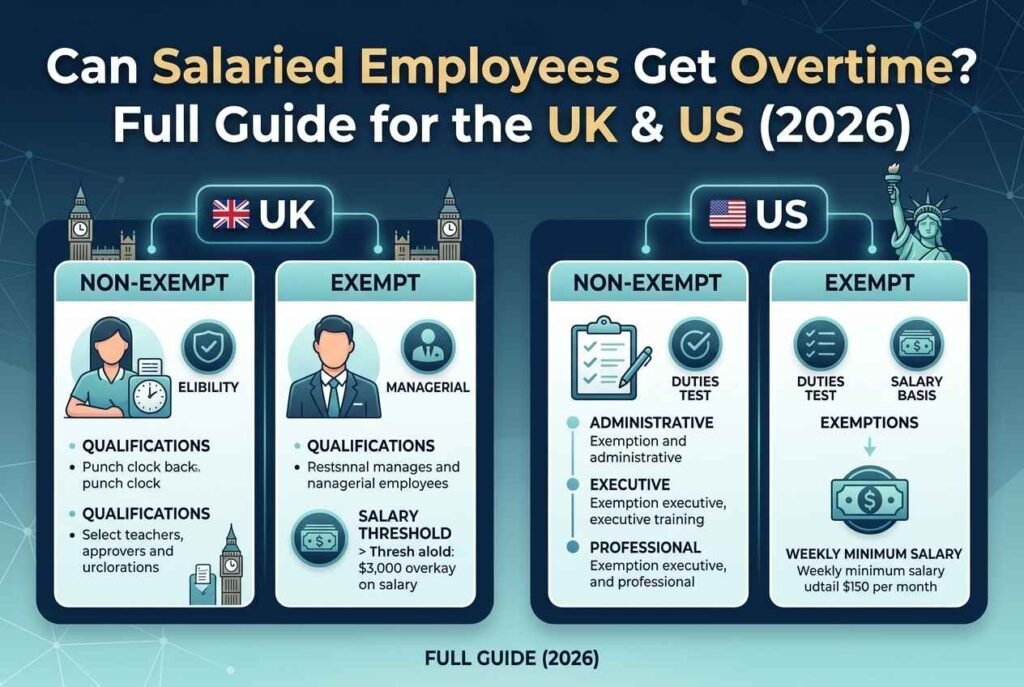
Quick answer: It depends which country you’re in. In the US, salaried employees can be entitled to overtime under the Fair Labor Standards Act (FLSA) unless they’re correctly classified as “exempt” — which depends on both a salary threshold and a duties test. In the UK, there’s no general statutory right to overtime pay at all — it comes down entirely to your employment contract, with only a legal floor of the National Minimum Wage and a 48-hour average working week limit.
Being paid a salary, on its own, does not automatically mean you’re not entitled to overtime in either country — that’s one of the most common misconceptions this guide addresses. Once you know your gross pay, you can see exactly what overtime would add to your take-home pay using our free overtime and take-home pay calculator.
US: Exempt vs Non-Exempt Under the FLSA
The Fair Labor Standards Act (FLSA) requires covered employers to pay non-exempt employees overtime — 1.5× their regular rate — for all hours worked over 40 in a workweek. Salaried employees are not automatically excluded from this. Whether a salaried employee is entitled to overtime depends on whether they meet the requirements to be classified as exempt, which requires satisfying three separate tests:
- Salary basis test: The employee is paid a fixed salary that doesn’t fluctuate based on the quality or quantity of work performed.
- Salary level test: The salary meets or exceeds the federal minimum threshold (see below).
- Duties test: The employee’s actual job duties primarily fall into an exempt category — job title alone isn’t enough.
All three tests must be met for an employee to be exempt from overtime. A salaried employee who fails any one of them — even if they earn well above the salary threshold — is legally entitled to overtime pay under federal law.
The 2026 Federal Salary Threshold (Recently Changed)
The federal salary threshold for exemption has changed significantly in 2026. On May 15, 2026, the US Department of Labor formally reinstated the 2019 salary thresholds, rolling back a planned Biden-era increase after federal courts in Texas struck down the higher rule and the DOL dropped its appeal. As of today, the federal thresholds are:
| Exemption category | Minimum salary |
|---|---|
| Executive, Administrative, Professional (EAP) | $684/week ($35,568/year) |
| Highly Compensated Employee (HCE) | $107,432/year |
A salaried employee paid below $35,568 a year cannot legally be classified as exempt under the EAP categories, regardless of their duties or job title — they must receive overtime for hours worked over 40 a week. The rejected Biden-era rule would have raised this to $1,128/week ($58,656/year) by 2025, which would have made millions more salaried workers eligible for overtime; that increase is no longer in effect. Congress has since introduced a bill (the Restoring Overtime Pay Act of 2026) proposing a phased increase to the threshold, but as of now it has not been enacted — the 2019 figures remain the current legal standard.
The Duties Test: What Actually Makes a Job “Exempt”
Meeting the salary threshold alone doesn’t make an employee exempt — their actual day-to-day duties must also primarily fall into one of these categories:
- Executive exemption: Primary duty is managing the business or a department, regularly directing the work of at least two other full-time employees, with genuine authority to hire, fire, or influence those decisions.
- Administrative exemption: Primary duty is office or non-manual work directly related to management or general business operations, involving the exercise of independent judgment on significant matters.
- Professional exemption: Work requiring advanced knowledge in a field of science or learning, typically obtained through specialized education (e.g. law, medicine, accounting), or certain creative/artistic professions.
- Computer employee exemption: Specific to systems analysts, programmers, software engineers, and similar roles meeting defined duty criteria.
- Outside sales exemption: Primary duty is making sales away from the employer’s place of business — notably, this exemption has no salary minimum at all.
A common misclassification issue: giving someone a manager-sounding job title doesn’t make them exempt if their actual daily work is mostly the same non-exempt tasks as the team they supposedly “manage.” The U.S. Department of Labor’s Wage and Hour Division overtime page sets out the full duties tests.
The Highly Compensated Employee (HCE) Exemption
Employees earning at least $107,432 a year (as of the 2026 reinstated threshold) can qualify for a separate, less strict exemption test: they only need to “customarily and regularly” perform at least one of the exempt executive, administrative, or professional duties, rather than meeting the full standard duties test. This makes it easier for very highly paid employees to be classified as exempt even if their day-to-day role doesn’t cleanly fit one exemption category.
State Law Can Set a Higher Bar Than Federal Law
The FLSA sets a federal floor, but individual states can — and several do — require a higher salary threshold or a stricter duties test for exemption. For example, New York and California have historically required salary thresholds well above the federal $35,568 figure. Where state law is stricter than federal law, employers must follow whichever standard is more favorable to the employee. If you’re unsure which applies, your state’s Department of Labor or equivalent agency publishes current state-specific thresholds.
UK: There’s No General Statutory Right to Overtime Pay
Unlike the US system of exempt/non-exempt classification, UK law takes a fundamentally different approach: there is no standalone legal right to overtime pay at all, salaried or otherwise. Whether you’re paid extra for working beyond your contracted hours depends entirely on what your employment contract says. Overtime law in the UK draws on several frameworks — the Employment Rights Act 1996, the Working Time Regulations 1998 (WTR), and the National Minimum Wage Act 1998 — but none of them create a general entitlement to enhanced overtime pay.
This means a salaried UK employee can, in principle, be contractually required to work reasonable additional hours with no extra pay at all, provided two legal floors are respected:
- The National Minimum Wage floor: Your average hourly rate, including all hours actually worked (paid or unpaid overtime), must not fall below the National Minimum Wage or National Living Wage for your age.
- The 48-hour weekly limit: Under the Working Time Regulations 1998, most workers can’t be required to work more than an average of 48 hours a week (averaged over 17 weeks) unless they’ve signed a voluntary written opt-out.
UK: Contractual, Non-Guaranteed, and Voluntary Overtime
UK overtime arrangements generally fall into one of three types, and which type applies changes what you can be required to do:
- Guaranteed and compulsory: The employer must offer a set amount of overtime, and the employee must work it if offered — this is the strongest form of contractual overtime.
- Non-guaranteed: The employer doesn’t have to offer overtime, but if they do, the employee is contractually required to work it.
- Voluntary: Either side can decline — the employer doesn’t have to offer it, and the employee doesn’t have to accept it.
Whether overtime is paid, unpaid, or compensated with Time Off in Lieu (TOIL) instead of cash is, again, a matter for the contract or company policy — there’s no default legal rate like the US 1.5×, though “time and a half” and “double time” are common voluntary employer practices.
Timeline: How the Federal Overtime Threshold Got Here
- January 2020: DOL raises the EAP threshold from $455/week ($23,660/year) to $684/week ($35,568/year), and the HCE threshold to $107,432/year.
- 2024: A new DOL rule proposes raising the EAP threshold to $844/week in 2024, then $1,128/week ($58,656/year) in 2025, with automatic increases every three years, plus a higher HCE threshold of up to $151,164/year.
- Late 2024: Federal courts in Texas strike down the 2024 rule, ruling the DOL placed too much weight on salary level relative to job duties.
- Early May 2026: The DOL drops its appeal of the court rulings, and the Fifth Circuit dismisses the case.
- May 15, 2026: The DOL formally reinstates the 2019 thresholds ($684/week EAP, $107,432/year HCE) as the current federal standard.
- May 2026 onward: Congress introduces the Restoring Overtime Pay Act of 2026, proposing a phased threshold increase starting at $45,000/year in 2026 and rising to roughly the 55th percentile of full-time salaried workers by 2030 — not yet law as of this guide.
This back-and-forth is a useful reminder that the threshold is a regulatory figure, not a fixed constant — it’s worth checking the Department of Labor’s overtime page periodically if your classification is close to the line.
Common Misconceptions
- “Salaried means no overtime.” False in both countries. In the US, only correctly classified exempt salaried employees lose overtime eligibility — many salaried workers are legally non-exempt. In the UK, salaried employees can still be entitled to overtime if their contract says so.
- “A manager job title automatically means exempt (US).” False — the duties test looks at actual day-to-day responsibilities, not the job title on the contract.
- “UK employers must pay 1.5x for overtime.” False — there’s no statutory overtime rate in the UK at all. Any enhanced rate is a matter of contract or company policy, not law.
- “If I earn above the FLSA threshold, I’m definitely exempt.” False — the salary level is only one of three tests; the duties test must also be met.
- “Unpaid overtime is always legal in the UK.” Not necessarily — if unpaid overtime pushes your effective hourly rate below the National Minimum Wage, that’s a legal breach even without a specific overtime law.
What to Do If You Think You’re Misclassified or Underpaid
- US: If you believe you’ve been wrongly classified as exempt, you can file a complaint with the Department of Labor’s Wage and Hour Division, which can investigate and, where applicable, recover unpaid overtime (back pay) on your behalf. Many states also have their own wage and hour enforcement agencies.
- UK: Start by checking your written employment contract for what it actually says about overtime. If your effective hourly rate (including unpaid overtime) falls below the National Minimum Wage, you can raise this with your employer, and ultimately with HMRC or an employment tribunal if unresolved. ACAS (the Advisory, Conciliation and Arbitration Service) offers free, impartial guidance on UK employment disputes, including overtime and working time issues.
Worked Example: Does a Salaried Employee Get Overtime?
| Scenario | Entitled to overtime? |
|---|---|
| US: salaried, $32,000/year, performs routine data entry | Yes — below the $35,568 EAP threshold, non-exempt regardless of duties |
| US: salaried, $60,000/year, manages a team of 5 with hiring authority | No (likely exempt) — meets salary threshold and executive duties test |
| US: salaried, $60,000/year, “Team Lead” title but does the same tasks as the team | Possibly Yes — fails the duties test despite the title and salary |
| UK: salaried, contract states “reasonable overtime, unpaid” | No cash overtime — but average hourly rate must still clear the NMW |
| UK: salaried, contract includes a paid overtime clause at 1.5× | Yes — the contract creates the entitlement, not the law |
Key Terms Explained
- Exempt (US): A salaried employee who meets all three FLSA tests and is not legally entitled to overtime.
- Non-exempt (US): An employee, salaried or hourly, who is legally entitled to overtime pay for hours over 40/week.
- EAP exemption: Executive, Administrative, and Professional — the main categories of exempt duties under the FLSA.
- HCE: Highly Compensated Employee — a higher-paid category with a simplified duties test.
- Working Time Regulations 1998 (UK): The law capping average weekly working hours at 48, including overtime, unless opted out.
- TOIL (UK): Time Off in Lieu — paid time off given instead of cash payment for overtime worked.
- Opt-out agreement (UK): A voluntary written agreement allowing a worker to exceed the 48-hour weekly limit.
Related Guides
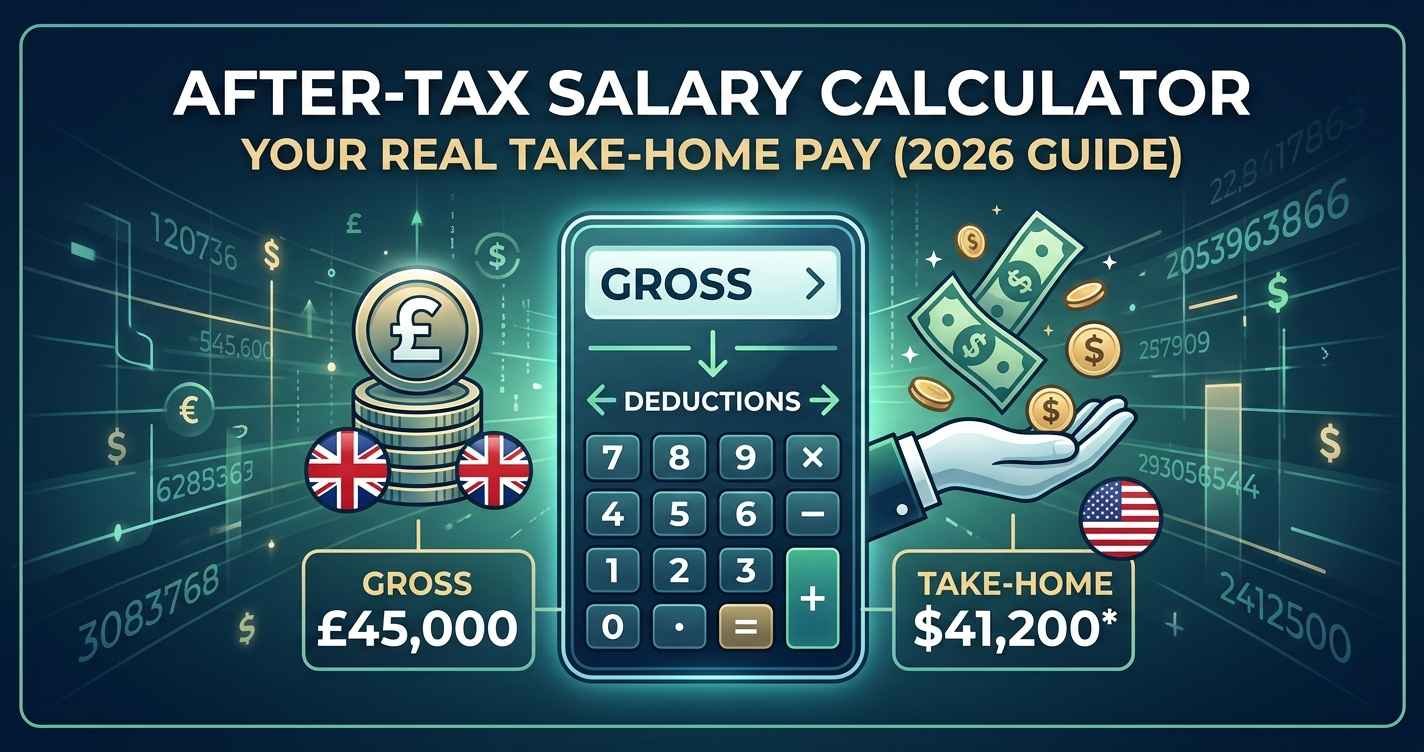
- After-Tax Salary Calculator: How to Work Out Your Real Take-Home Pay — see what overtime actually adds to your take-home pay after tax.
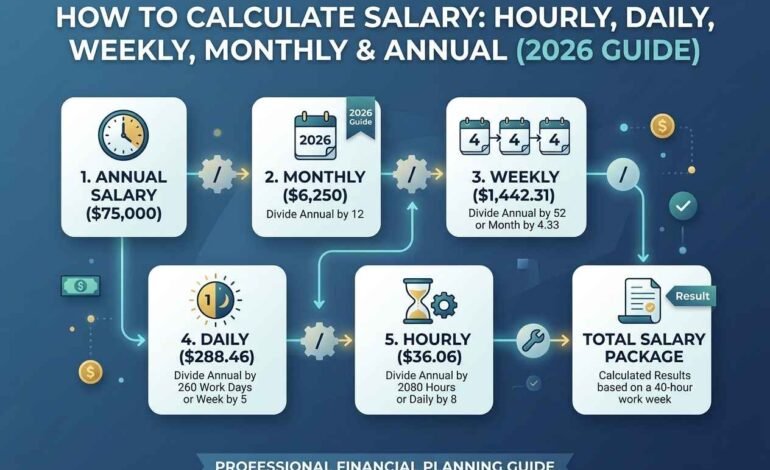
- How to Calculate Salary: Hourly, Daily, Weekly, Monthly & Annual — the formula for adding overtime pay to a salary.
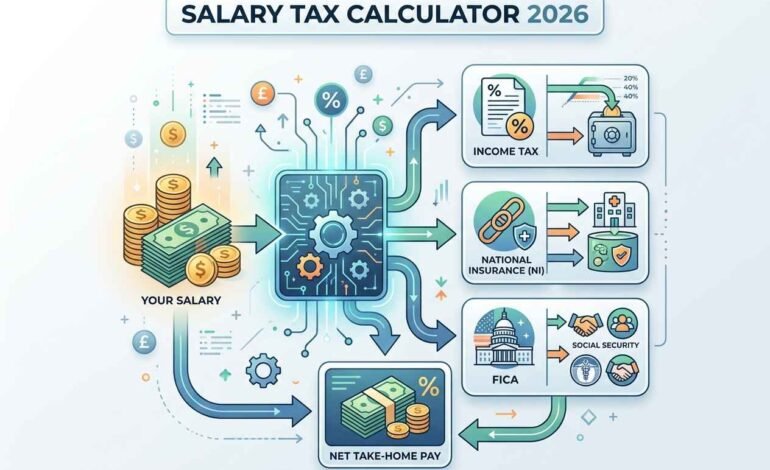
- Tax Calculator for Salary: How Income Tax, NI & FICA Are Actually Calculated — why overtime and bonuses can look more heavily taxed than they really are.
- Free Overtime, Hourly-to-Salary and Take-Home Pay Calculator — calculate your own overtime pay and take-home pay.
Frequently Asked Questions
Can salaried employees get overtime in the US?
Yes, if they’re classified as “non-exempt” under the FLSA — which depends on their salary level and their actual job duties, not just the fact that they’re paid a salary.
What is the current FLSA salary threshold for overtime exemption?
As of May 2026, the federal threshold is $684/week ($35,568/year) for the standard executive, administrative, and professional exemptions, and $107,432/year for the Highly Compensated Employee exemption.
Do salaried employees get overtime in the UK?
Only if their employment contract provides for it. UK law doesn’t create a general statutory right to overtime pay — the main legal protections are the National Minimum Wage floor and the 48-hour average weekly limit.
Can my employer make me work overtime for free?
In the UK, generally yes, if your contract allows it and your average hourly rate (including that overtime) doesn’t fall below the National Minimum Wage. In the US, non-exempt employees must be paid overtime by law — unpaid overtime for a non-exempt employee is a violation.
Does a high salary automatically mean I’m not entitled to overtime (US)?
Not on its own. A high salary can satisfy the salary threshold, but the employee’s actual duties must also meet one of the exempt categories (executive, administrative, professional, etc.) for the exemption to legally apply.
What should I do if I think I’ve been wrongly classified as exempt?
In the US, you can raise it with your employer or file a complaint with the Department of Labor’s Wage and Hour Division. In the UK, check your contract first, then contact ACAS or HMRC if your pay falls below the National Minimum Wage once overtime is included.
Is there a legal overtime rate in the UK, like 1.5x in the US?
No. There’s no statutory overtime rate in the UK — any enhanced rate (time-and-a-half, double time, etc.) is set by the employment contract or company policy, not by law.
Why did the FLSA overtime threshold change in 2026?
A federal court in Texas struck down a Biden-era rule that would have significantly raised the threshold, and in May 2026 the Department of Labor dropped its appeal and formally reinstated the earlier 2019 salary figures as the current legal standard.
Could the overtime threshold rise again soon?
Possibly. A bill introduced in Congress in 2026 proposes a phased increase to the threshold over several years, but as of this guide it had not been passed into law, so the 2019 figures remain current.
Key Takeaways
- Being salaried does not automatically mean no overtime, in either the US or the UK.
- US: overtime eligibility depends on the FLSA’s salary and duties tests — not job title, and not salary alone.
- UK: overtime pay is a matter of contract, with only the National Minimum Wage and the 48-hour limit as legal floors.
- The federal US exemption threshold was rolled back to $35,568/year in May 2026 — a significant recent change worth knowing if your classification hasn’t been reviewed recently.
See also: Overtime for Salaried Employees: How It’s Actually Calculated — the standard method vs the Fluctuating Workweek method, with worked examples.
Sources
Figures and rules in this guide are based on the US Department of Labor, Wage and Hour Division (Overtime), the GOV.UK National Minimum Wage rates, and published reporting on the DOL’s May 2026 technical amendment reinstating 2019 FLSA salary thresholds. This guide is for general information only and is not legal advice — for advice on your specific situation, consult an employment lawyer, ACAS (UK), or your state’s Department of Labor (US).