How to Calculate Salary: Hourly, Daily, Weekly, Monthly & Annual (2026 Guide)

Quick answer: To calculate salary, multiply your pay rate by the number of pay periods in a year — for example, hourly rate × hours per week × 52 gives your annual salary. The same core formula, applied in different directions, also lets you work out a pro-rata salary for part-time or partial-year work, a pay rise, a percentage increase, or pay including overtime.
This guide walks through every common salary calculation with worked examples for both the UK and US, using 2026 figures. If you also want to know what you’ll actually take home after tax, see our guides to the after-tax salary calculator and salary after tax by pay period, or use the free calculator directly.
The Core Formula: Hourly Rate to Annual Salary
The most common salary calculation converts an hourly rate into an annual salary:
Annual salary = Hourly rate × Hours per week × 52
For example, at the UK’s National Living Wage of £12.71 an hour (from April 2026, per GOV.UK) for a standard 37.5-hour week, that’s:
£12.71 × 37.5 × 52 = £24,784.50 a year
In the US, at $20/hour for a standard 40-hour week:
$20 × 40 × 52 = $41,600 a year
To reverse the calculation and find an hourly rate from an annual salary, divide instead: Hourly rate = Annual salary ÷ 52 ÷ hours per week.
How to Calculate Daily, Weekly, and Monthly Salary from Annual
Once you have an annual salary, every other pay period is a simple division:
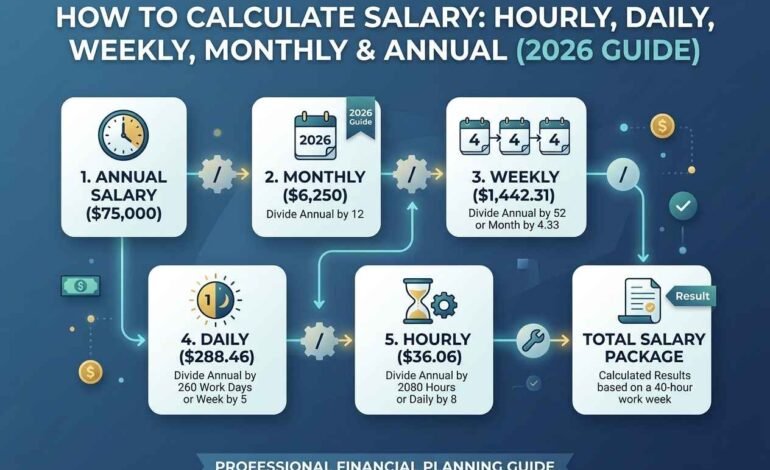
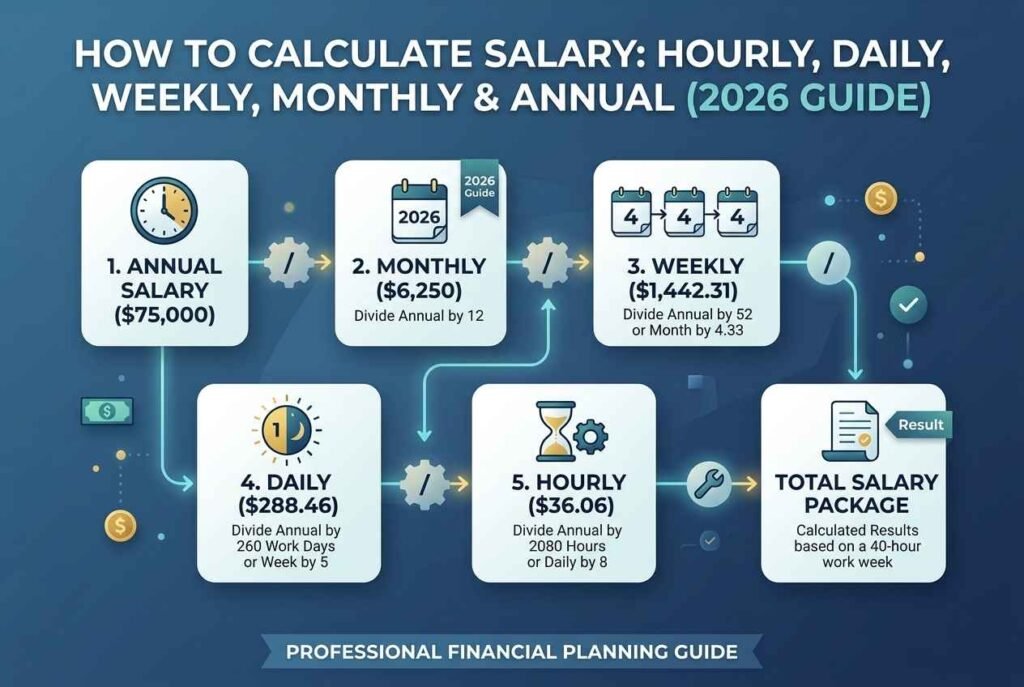
- Monthly salary = Annual salary ÷ 12
- 4-weekly salary (UK) = Annual salary ÷ 13
- Weekly salary = Annual salary ÷ 52
- Daily salary = Annual salary ÷ 260 (5-day working week, 52 weeks) or ÷ 365 for a calendar-day rate
Example: a £36,000 annual salary is £3,000 a month, £2,769.23 every 4 weeks, £692.31 a week, and £138.46 a working day.
How to Calculate a Pro-Rata Salary
A pro-rata salary scales a full-time annual salary down for someone working fewer hours or fewer days:
Pro-rata salary = Full-time salary × (Hours or days actually worked ÷ Full-time hours or days)
Example: a full-time role pays £30,000 a year for 5 days a week. A part-time employee working 3 days a week gets:
£30,000 × (3 ÷ 5) = £18,000 a year
Pro-rata for a partial year (starting or leaving mid-year)
If someone joins partway through the year, pro-rate by the number of days actually worked out of the full period:
Pro-rata salary = Full annual salary × (Days worked ÷ Total days in the period)
Example: a £36,000 annual salary for someone who starts on 1 September and works 122 remaining days of the year: £36,000 × (122 ÷ 365) = £12,032.88 for that partial year.
How to Calculate a Pay Rise
To find a new salary after a percentage pay rise:
New salary = Current salary × (1 + Percentage increase ÷ 100)
Example: a £32,000 salary with a 5% pay rise becomes £32,000 × 1.05 = £33,600 — a cash increase of £1,600.
In the US: a $55,000 salary with a 4% raise becomes $55,000 × 1.04 = $57,200 — a cash increase of $2,200.
How to Calculate the Percentage Increase Between Two Salaries
If you know your old and new salary and want the percentage change:
Percentage increase = ((New salary − Old salary) ÷ Old salary) × 100
Example: moving from a £28,000 salary to a £30,800 salary: ((30,800 − 28,000) ÷ 28,000) × 100 = 10%.
This is useful for checking whether an offered pay rise matches what was promised, or for comparing raises across different salary levels on a like-for-like basis.
How to Calculate Salary With Overtime Added
To add overtime to a salaried role, first convert the annual salary to an hourly equivalent, then calculate the overtime pay separately before adding it back:
- Hourly equivalent = Annual salary ÷ 52 ÷ standard weekly hours
- Overtime pay = Hourly equivalent × Overtime multiplier × Overtime hours × 52
- Total annual pay = Annual salary + Overtime pay
Example: a £28,000 salary for a standard 37.5-hour week gives an hourly equivalent of £28,000 ÷ 52 ÷ 37.5 = £14.36. Adding 5 hours a week of overtime at 1.5x: £14.36 × 1.5 × 5 × 52 = £5,590.20, for a total annual pay of £33,590.20. Our overtime and hourly-to-salary calculator does this calculation automatically, including UK/US take-home pay after tax.
How to Calculate Back Pay
Back pay is owed when someone was underpaid for hours already worked — for example, after a late pay rise or a minimum wage underpayment:
Back pay owed = (Correct rate − Rate actually paid) × Hours worked in the underpaid period
Example: an employee should have been paid the £12.71 National Living Wage but was paid £11.21 for 12 weeks at 35 hours a week: (£12.71 − £11.21) × 35 × 12 = £630 owed in back pay. For a pay rise applied late, use the same formula with the new and old salary’s hourly equivalents in place of the correct and actual rate.
Key Salary Calculation Terms
- Full-time equivalent (FTE): The salary a role would pay if worked full-time, used as the baseline for pro-rata calculations.
- Pro-rata: Latin for “in proportion” — scaling a full-time salary down for reduced hours or a partial period.
- Hourly equivalent: A salaried role’s pay rate expressed as an hourly figure, used to calculate overtime or pro-rata pay.
- Back pay: Money owed for hours already worked but underpaid at the time.
- Gross salary: Pay before tax and other deductions — every calculation in this guide is a gross figure.
Worked Examples: Common Salary Calculations
| Calculation | Example | Result |
|---|---|---|
| Hourly to annual (UK) | £12.71/hr × 37.5hrs × 52 | £24,784.50 |
| Hourly to annual (US) | $20/hr × 40hrs × 52 | $41,600 |
| Annual to monthly | £36,000 ÷ 12 | £3,000 |
| Pro-rata (part-time, 3 of 5 days) | £30,000 × (3÷5) | £18,000 |
| Pro-rata (partial year, 122 of 365 days) | £36,000 × (122÷365) | £12,032.88 |
| Pay rise (5%) | £32,000 × 1.05 | £33,600 |
| Percentage increase | (£30,800−£28,000)÷£28,000 | 10% |
| Salary + overtime | £28,000 + £5,590.20 | £33,590.20 |
| Back pay (12 weeks, 35hrs/wk) | £1.50 × 35 × 12 | £630 |
Common Mistakes When Calculating Salary
- Using 48 weeks instead of 52. Some people mistakenly deduct holiday weeks when converting hourly to annual salary — standard salary calculations use the full 52 weeks, since paid holiday is already included in an annual salary.
- Confusing calendar days with working days. A daily rate based on 365 days will be noticeably lower than one based on 260 working days — check which one a contract or calculator is using.
- Applying a percentage rise to the wrong base. A pay rise is always a percentage of the current salary, not the desired new salary — working backwards from a target figure requires the percentage-increase formula instead.
- Forgetting that pro-rata salary is still a full-time-equivalent figure for pension and benefit calculations in many UK schemes, even though the cash paid is lower.
- Mixing up gross and net figures. Every formula in this guide calculates gross salary — for what you’ll actually take home after tax, see the after-tax guides linked below.
From Gross Salary to Take-Home Pay: What’s Next
Every calculation above gives a gross figure — before Income Tax and National Insurance (UK) or Federal Income Tax and FICA (US) are deducted. To see what you’d actually take home:
- Read After-Tax Salary Calculator: How to Work Out Your Real Take-Home Pay for the full UK/US tax formula and worked examples.
- Read Salary After Tax Calculator: Weekly, Monthly & Annual Take-Home Pay for a pay-period breakdown and Scotland vs rest-of-UK comparison.
- Or use the free overtime, hourly-to-salary and take-home pay calculator to do the whole calculation — gross to net, including overtime — in one step.
How Salary Is Calculated: Salaried vs Hourly Workers
Salaried employees are paid a fixed annual amount, split evenly across pay periods regardless of the exact hours worked in a given week — a salaried employee’s pay doesn’t usually change if one week has slightly more or fewer hours, since holiday and typical fluctuations are already priced into the annual figure.
Hourly employees are paid strictly for hours worked, calculated as hours worked × hourly rate for each pay period, with no fixed annual guarantee. This is why converting between the two (hourly to salary, or salary to an hourly equivalent) is one of the most common salary calculations — it lets you compare a job advertised one way against an offer or current role expressed the other way.
How to Calculate Salary When Comparing Job Offers
When two offers use different pay structures — one annual salary, one hourly or day rate — convert both to the same annual gross figure before comparing:
- Convert any hourly or daily rate to an annual figure using the formulas above.
- Add the value of regular overtime, if guaranteed, using the overtime formula.
- Compare the two annual gross figures directly, then check take-home pay if the two roles fall in different tax situations (for example, one salary pushes you into a higher tax band).
A role advertised at £320/day and one advertised at £70,000/year aren’t directly comparable until both are converted to the same annual basis — £320 × 220 billable days is £70,400, which is very close to the salaried offer, despite looking like very different numbers at first glance.
How to Calculate Salary With a Bonus or Commission
A bonus or commission is added on top of base salary after it’s earned, rather than being averaged into your regular pay:
Total annual pay = Base salary + Bonus/commission earned in the year
For a guaranteed or target bonus expressed as a percentage, calculate it the same way as a pay rise: a £30,000 base salary with a 10% target bonus is £30,000 × 0.10 = £3,000, for a total on-target package of £33,000. For commission-based roles, total pay simply adds each commission payment as it’s earned: base salary + commission payment 1 + commission payment 2, and so on, across the year.
How to Calculate a Blended (Weighted Average) Hourly Rate
If you work different rates for different hours — for example, a base rate for standard hours and a higher rate for weekend shifts — use a weighted average to find your effective hourly rate:
Blended rate = (Hours at Rate 1 × Rate 1 + Hours at Rate 2 × Rate 2 + …) ÷ Total hours
Example: 30 hours at £12.71/hr plus 10 hours at £16/hr: (30 × 12.71 + 10 × 16) ÷ 40 = (381.30 + 160) ÷ 40 = £13.53/hr blended rate. Multiplying this blended rate by 40 hours and 52 weeks gives the equivalent annual salary for that mixed-rate work pattern.
Checking Your Salary Calculation Against National Averages
Once you’ve calculated a salary figure, it can help to sanity-check it against national data. Median gross annual earnings for full-time UK employees were £39,039 in April 2025 (ONS), while US median weekly earnings for full-time workers were $1,204 in 2025, or roughly $62,608 annualised (BLS). If your calculated salary looks far outside these ranges for a broadly similar role, it’s worth double-checking your hours, rate, or pay-period assumptions.
Salary Calculation Cheat Sheet
| What you want to calculate | Formula |
|---|---|
| Annual salary from hourly rate | Hourly rate × Hours/week × 52 |
| Hourly rate from annual salary | Annual salary ÷ 52 ÷ Hours/week |
| Monthly salary | Annual salary ÷ 12 |
| Weekly salary | Annual salary ÷ 52 |
| Daily rate | Annual salary ÷ 260 (working days) |
| Pro-rata (reduced hours) | Full-time salary × (Hours worked ÷ Full-time hours) |
| Pro-rata (partial year) | Annual salary × (Days worked ÷ Total days) |
| New salary after a pay rise | Current salary × (1 + % increase ÷ 100) |
| Percentage increase between two salaries | ((New − Old) ÷ Old) × 100 |
| Salary with overtime added | Base salary + (Hourly equivalent × Multiplier × OT hours × 52) |
| Back pay owed | (Correct rate − Rate paid) × Hours worked |
How Payroll Software Calculates Salary (and Why It May Differ Slightly)
Payroll systems generally use the same formulas in this guide, but a few technical details can create small differences from a manual calculation:
- Daily rate method: Some employers use calendar days (365) for pro-rata calculations, others use working days (260) — both are legitimate methods but produce different results, so check which method applies to your contract.
- Rounding rules: Payroll software typically rounds each pay period independently, which can create tiny cumulative differences from a single annual calculation over a full year.
- Leap years: A 366-day year very slightly changes a calendar-day pro-rata calculation compared with a standard 365-day year.
These differences are usually a matter of pennies or a few pounds/dollars — if your payslip differs from a manual calculation by more than that, it’s worth asking payroll which method and dates they used.
Frequently Asked Questions
How do I calculate my salary from my hourly rate?
Multiply your hourly rate by the number of hours you work per week, then by 52 weeks: Annual salary = Hourly rate × Weekly hours × 52.
How do I calculate my hourly rate from my annual salary?
Divide your annual salary by 52, then by your weekly hours: Hourly rate = Annual salary ÷ 52 ÷ Weekly hours.
How do I calculate a pro-rata salary for part-time work?
Multiply the full-time salary by the proportion of hours or days you actually work: Pro-rata salary = Full-time salary × (Hours or days worked ÷ Full-time hours or days).
How do I calculate my salary if I started partway through the year?
Multiply your full annual salary by the number of days you’ll actually work in that period, divided by the total days in the period: Pro-rata salary = Annual salary × (Days worked ÷ Total days).
How do I calculate a percentage pay rise?
Multiply your current salary by 1 plus the percentage increase (as a decimal): New salary = Current salary × (1 + Percentage ÷ 100).
How do I work out what percentage pay rise I got?
Subtract your old salary from your new salary, divide by the old salary, then multiply by 100: Percentage increase = ((New − Old) ÷ Old) × 100.
Does calculating my salary this way include tax?
No. Every formula in this guide calculates gross salary, before Income Tax, National Insurance, or FICA are deducted. See our after-tax salary guides for take-home pay calculations.
How many weeks are used to calculate an annual salary?
52 weeks. Paid annual leave is already included in an annual salary, so you don’t subtract holiday weeks when converting an hourly rate to an annual figure.
How do I calculate salary including regular overtime?
Convert your salary to an hourly equivalent, calculate the overtime pay separately using your overtime multiplier, then add it to your base salary. See the worked example above.
How is back pay calculated?
Multiply the difference between the correct rate and the rate you were actually paid by the number of hours worked during the underpaid period.
How do I calculate a blended hourly rate if I work at two different pay rates?
Multiply the hours at each rate by that rate, add the results together, then divide by your total hours worked. See the worked example above.
How do I calculate my annual salary if I’m paid a day rate?
Multiply your day rate by the number of days you expect to work in a year (up to 260 for a standard 5-day working pattern, or fewer for contractors with gaps between contracts).
Does a bonus count towards my annual salary?
A guaranteed or contractual bonus is usually included in total annual pay figures, but base salary and bonus are typically shown separately since bonus amounts can vary year to year.
Key Takeaways
- The core salary formula is Hourly rate × Hours per week × 52 — every other calculation in this guide builds on it.
- Pro-rata, pay rises, percentage increases, overtime, and back pay all use variations of the same basic formula.
- Every calculation here is a gross figure — use our after-tax guides or the free calculator to see what you’d actually take home.
See also: Tax Calculator for Salary: How Income Tax, NI & FICA Are Actually Calculated — covers tax codes, self-employed tax, second jobs, and bonus tax.
See also: Can Salaried Employees Get Overtime? Full Guide for the UK & US — FLSA exempt/non-exempt rules and the 2026 threshold change, plus UK contract-based overtime rights.
See also: Overtime for Salaried Employees: How It’s Actually Calculated — the standard method vs the Fluctuating Workweek method, with worked examples.
Sources
Figures in this guide are based on the GOV.UK National Minimum Wage and National Living Wage rates for April 2026. Figures are for illustration only — for an exact figure based on your own hours, pay structure, and location, use the free salary calculator.