
President Donald Trump announced Friday, September 18, 2026, that he is “banning” CNN, MS NOW, and Politico from the White House, escalating his long-running conflict with news organizations he accuses of unfair coverage. The announcement, posted on Truth Social, marks one of the most direct attempts yet by the administration to restrict White House access for specific news outlets over their reporting, and it immediately drew warnings from First Amendment advocates that any such ban would be unconstitutional.
Here’s everything currently known about the announcement, how the targeted outlets and press freedom groups have responded, and how this fits into a broader pattern of the administration’s efforts to limit media access.
Quick Summary (Read This First)
- Trump announced on Truth Social Friday that he is banning CNN, MS NOW, and Politico from the White House, effective immediately.
- He accused the outlets of “constant ‘reporting’ FAKE NEWS” and writing “FICTION and LIES.”
- When asked directly why, Trump initially said “No reason,” and offered few specifics on how the ban would actually be enforced.
- As of Friday evening, journalists from all three outlets remained on White House grounds, with no clear indication the ban had actually been implemented.
- Trump said the ban could be lifted if the outlets “could straighten themselves out” and warned that other outlets could face similar action.
- CNN, Politico, and press freedom organizations immediately pushed back, calling any such ban unconstitutional and a violation of the First Amendment.
- This follows earlier efforts by the administration to restrict access for the Associated Press and individual reporters, some of which are still being fought in court.
Now let’s look at exactly what Trump said and how the situation has unfolded.
What Exactly Did Trump Say?
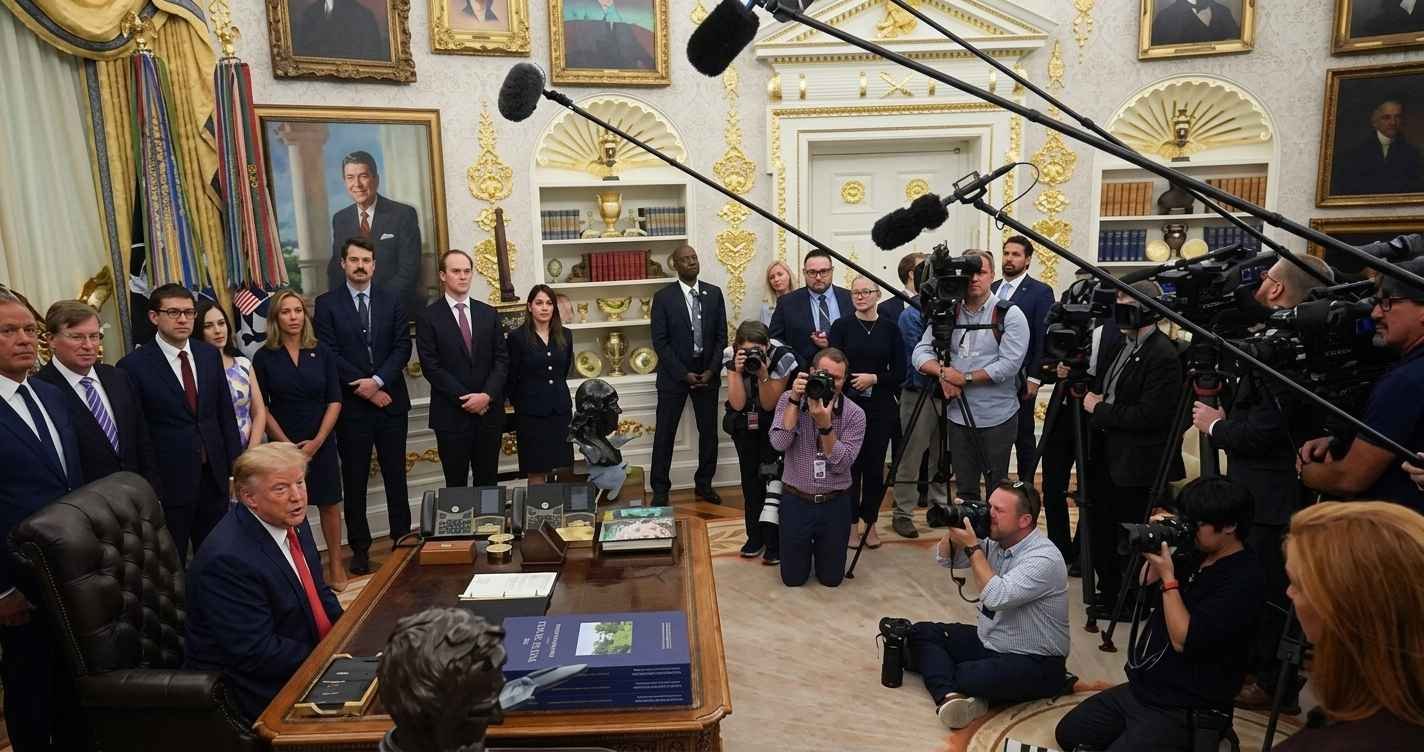
In a Truth Social post Friday afternoon, Trump wrote: “I am proud to announce that, effective immediately, I am banning Fake News CNN, MSNOW … and Politico … from the White House as a result of their constant ‘reporting’ FAKE NEWS!” He added that “Media Outlets shouldn’t be able to constantly write or report FICTION and LIES when they’re covering the President of the United States, the Trump Administration, or the United States of America.”
When reporters pressed him for details, Trump offered little clarity on how the ban would actually function. Asked why he announced it, he replied simply, “No reason.” Asked what the ban would look like in practice, he said: “It’s a very simple ban. I don’t want them in my office. I don’t want them here. I would say the ban would go as far as you can.” He also suggested the ban was not necessarily permanent, saying it could be lifted if the targeted outlets “could straighten themselves out” and began publishing coverage he considered more favorable. Trump further warned that “other outlets” could face similar restrictions, without specifying which ones.
Notably, Trump did not identify any specific report or story from any of the three outlets that prompted the announcement.
Did the Ban Actually Take Effect?
Despite Trump’s “effective immediately” language, there was no clear indication the administration had actually taken concrete steps to implement the ban. As of Friday afternoon and evening, journalists from CNN, MS NOW, and Politico remained on White House grounds and continued working from their normal spaces. A CNN team was also functioning that day as part of the assigned television pool covering Vice President JD Vance.
According to a source familiar with the matter, even some White House staffers, including members of the press shop, were reportedly caught off guard by the announcement and were left scrambling to figure out exactly how it would affect daily operations. That disconnect between Trump’s public declaration and any formal administrative action left significant uncertainty about what, if anything, would change in practice.
How the Targeted Outlets and Press Groups Responded
All three outlets, along with leading press freedom organizations, quickly pushed back on the announcement.
CNN issued a statement saying: “CNN stands fully behind our White House team and their fair and accurate reporting. We have a right under the U.S. Constitution to do that reporting without hindrance or interference from the government. Should the ban which President Trump threatened go ahead, it would be an illegal assault on that fundamental and constitutionally-protected right.”
Politico responded in a similar vein, stating it “will continue to fairly report on this White House and future ones,” and that it “will vigorously defend our First Amendment rights against any attempt to restrict them.”
Bruce D. Brown, president of the Reporters Committee for Freedom of the Press, was blunt in his assessment: “A ban like this would be flatly unconstitutional. The First Amendment is clear that once the White House invites in some journalists, it can’t ban others because it doesn’t like their reporting.”
Jacqui Heinrich, president of the White House Correspondents’ Association, added that the organization “stands in defense of our colleagues at CNN, MSNOW, and Politico who are being singled out for doing their jobs.”
Neither MS NOW nor the White House Correspondents’ Association immediately responded to some outlets’ requests for further comment, and the White House itself had not, as of the initial reporting, provided additional clarification on implementation.
Part of a Longer Pattern of Media Access Fights
Friday’s announcement is the latest, and most sweeping, move in a series of escalating clashes between the Trump administration and the press over White House access, stretching back years and continuing throughout his second term.
- 2018: During Trump’s first term, the White House briefly suspended the press pass of then-CNN correspondent Jim Acosta. A federal judge later ordered the credential restored.
- Associated Press ban: Shortly after returning to office, Trump barred AP journalists from the Oval Office, Air Force One, and certain other events after the outlet declined to exclusively adopt his preferred name change from the Gulf of Mexico to the “Gulf of America.” The AP sued, and that case remains ongoing.
- Lawsuits against major outlets: Trump has also pursued legal action against news organizations including the BBC, The New York Times, and The Wall Street Journal over coverage he considered unfavorable. The suits against The Times and The Journal were subsequently dismissed, while the BBC has moved to have the case against it thrown out.
- Press pool control: The White House took over the process of selecting the presidential press pool from the White House Correspondents’ Association last year, a departure from the decades-long system previously managed by the press corps itself.
- Pentagon and Treasury restrictions: The Defense Department has separately moved to restrict press access to its building, with a federal judge striking down parts of that credentialing policy earlier this year. The Pentagon then issued a revised, still-restrictive policy that was also blocked in court, though that ruling has been stayed pending appeal. The Treasury Department also denied press credentials to at least one outlet last month.
Legally, courts have previously drawn a distinction between different types of press access. The U.S. Court of Appeals for the D.C. Circuit has held that once the White House opens general press facilities to journalists, it cannot arbitrarily deny access to specific outlets, and any restrictions on press credentials must come with due process. However, a divided appellate panel ruled last year that the White House retains broader discretion over who enters more restricted spaces, such as the Oval Office or Air Force One, a distinction that is likely to be central to any legal fight over this latest announcement.
Why This Announcement Matters
Even setting aside the question of whether the ban is ever formally enforced, legal experts and press advocates say the announcement itself represents a significant escalation. Previous access disputes involving the AP, the Pentagon, and individual reporters like Jim Acosta typically centered on narrower disputes, a specific naming convention, a single credential, or access to particular restricted spaces like the Oval Office. Friday’s announcement, by contrast, named three entire news organizations at once and tied their access directly and explicitly to the tone and content of their coverage, with Trump himself suggesting the outlets could regain access only by changing how they report on him.
That framing is precisely what concerns First Amendment advocates most. Courts have generally been willing to give the executive branch some discretion over logistics, who fits in a small room, how a press pool rotates, but explicitly conditioning access on favorable coverage strikes at the heart of what the First Amendment’s press protections are designed to prevent: government retaliation against journalists for reporting the government dislikes. Whether or not Friday’s statement translates into an actual, lasting policy, press freedom organizations argue that even the threat itself sends a chilling message to news organizations covering the White House.
At the same time, Trump’s own comments suggest he is aware the ban may not hold up if challenged, framing the announcement partly as a statement of principle rather than a guaranteed, lasting policy. That ambiguity, a forceful public declaration paired with uncertain follow-through, has become a recurring pattern in how the administration has approached its disputes with the press throughout Trump’s second term.
What Happens Next
Given the immediate, unified pushback from press freedom groups and the outlets themselves, a legal challenge appears highly likely if the administration takes any concrete steps to formally bar these organizations from White House grounds or press briefings. Trump himself acknowledged the ban might not survive legal scrutiny, telling reporters, “I think it’s good to point it out whether it survives or doesn’t,” suggesting the announcement may function as much as a public statement of intent and pressure tactic as an immediately enforceable policy. As of the most recent reporting, journalists from all three outlets continued operating normally from the White House, and no formal legal notice or credentialing change had been confirmed.
Frequently Asked Questions
Which news outlets did Trump say he is banning?
Trump said he is banning CNN, MS NOW, and Politico from the White House.
Why did Trump say he was banning these outlets?
Trump cited what he called their “constant ‘reporting’ FAKE NEWS” and accused them of writing “FICTION and LIES,” though he did not point to any specific story or report that prompted the announcement, and told reporters “no reason” when directly asked.
Has the ban actually gone into effect?
As of the initial reporting, no. Journalists from all three outlets remained at the White House, and there was no clear indication the administration had taken formal steps to implement the ban.
Is banning specific news outlets from the White House legal?
Press freedom groups say no. The Reporters Committee for Freedom of the Press called it “flatly unconstitutional,” and courts have previously ruled that once the White House opens general press facilities, it cannot arbitrarily deny access to specific outlets over their coverage.
Could the ban be reversed?
Trump suggested it could be lifted if the outlets “could straighten themselves out,” implying more favorable coverage could lead to the restriction being dropped.
Has Trump restricted press access before?
Yes. His administration previously barred Associated Press journalists from certain spaces over a naming dispute, and courts are still weighing that case, along with other press access disputes at the Pentagon and Treasury Department.
What is MS NOW?
MS NOW is one of the outlets named in Trump’s announcement, referenced alongside CNN and Politico in his Truth Social post and in subsequent news coverage of the story.
Key Takeaways
- Trump announced Friday, September 18, 2026, that he is banning CNN, MS NOW, and Politico from the White House, effective immediately.
- He offered no specific reporting as justification and provided few concrete details on how the ban would actually be enforced.
- As of the initial reporting, journalists from all three outlets remained working at the White House with no confirmed formal action taken.
- CNN, Politico, and press freedom organizations immediately called any such ban unconstitutional.
- The move follows a pattern of escalating media access restrictions from the administration, including an ongoing legal fight over an earlier Associated Press ban.
- Legal experts say courts have previously ruled the White House cannot arbitrarily deny general press access to specific outlets over their coverage.