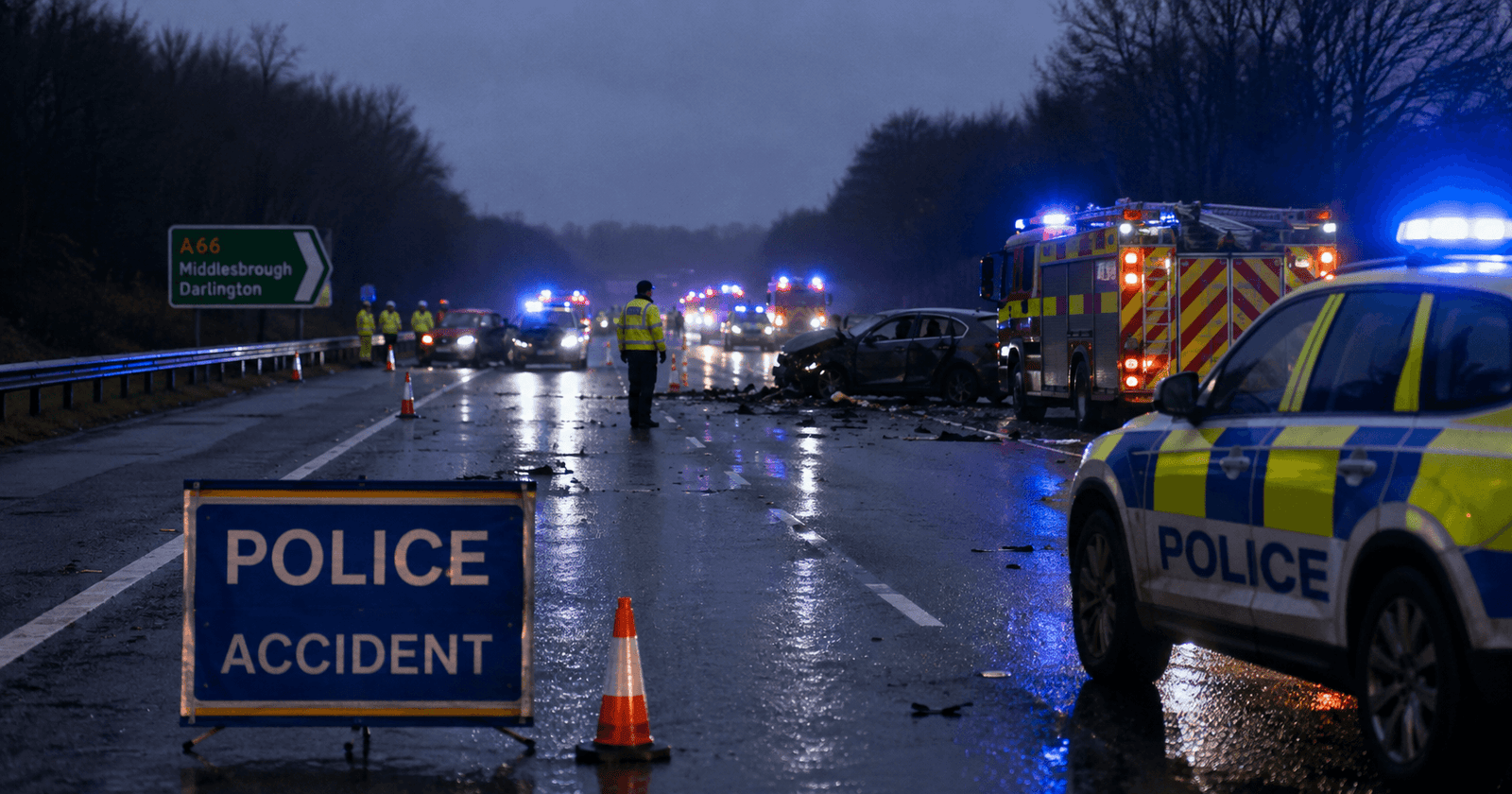

NEWS HOOK: A police chase that ended in a fatal crash on a major English road has widened into a full-blown organised crime investigation, with a dozen people now under arrest.
5W1H Summary
- Who: Cleveland Police, two officers named locally as Pc Blades and Pc Clough, and a group of suspects linked to organised crime
- What: A car crash on the A66 that killed seven people, including the two officers
- When: The crash happened over the weekend; the wave of arrests followed in the days after
- Where: The A66 near South Bank, Middlesbrough, in northeast England
- Why: A police pursuit of a Volkswagen Passat, linked to reports of “numerous incidents,” ended moments before the fatal collision
- How: Investigators say the crash is connected to a wider pattern of organised criminal activity, not a one-off traffic incident
What Happened
The tragedy began with a routine-sounding call. Cleveland Police received intelligence about a Volkswagen Passat connected to a string of incidents in the area. An armed response vehicle located the car and followed it for just under seven minutes. The pursuit ended when the Passat entered the A66 at South Bank travelling against the flow of traffic.
Officers called off the chase and continued driving on the correct side of the road. But roughly ten seconds later, the Passat crashed head-on into a vehicle carrying Pc Blades and Pc Clough. Both officers died. Family members have since remembered Pc Clough as someone who was “always on public duty.”
In total, seven people lost their lives in the crash. A separate vehicle, a Volvo XC60, was later traced and recovered in Middlesbrough as part of the investigation.
Why It Matters
This is not just a road safety story. Investigators have explicitly tied the crash to organised crime, which raises harder questions about the networks operating behind the wheel that night. It also puts renewed focus on the risks armed and pursuit units face when responding to fast-moving, high-stakes situations on public roads.
The deaths of two serving officers add a further layer of public concern. Police federations across the UK have long raised alarms about the dangers of pursuit driving, and this case is likely to feed into that ongoing debate.
Key Facts
- Seven people died in the crash, including two police officers
- Twelve people have been arrested in connection with organised criminal activity linked to the incident
- The pursuit lasted under seven minutes before it was called off
- The fatal collision occurred approximately ten seconds after the chase ended
- The Independent Office for Police Conduct (IOPC) is involved in reviewing the case
- Police have said there is no evidence the driving was carried out “for the purposes of TikTok,” addressing online speculation directly
Data
Fatal police pursuits remain rare relative to the volume of daily traffic stops in the UK, but when they do occur, the consequences are often severe. The IOPC has previously reported that pursuit-related fatalities tend to cluster on faster A-roads and dual carriageways, similar to the stretch of the A66 where this crash occurred, because of the higher closing speeds involved.
Global Impact
While this incident is a UK-based case, it echoes a wider international conversation about the tension between public safety and pursuit tactics. Police forces in the United States, Australia, and across Europe have each faced scrutiny in recent years over similar pursuit-related deaths, prompting reviews of when and how officers should chase a fleeing vehicle.
!– wp:heading –>
Expert Analysis
!– wp:paragraph –>
Assistant Chief Constable Wayne Fox, who leads the strategic response to the investigation, described it as “a fast-moving and complex investigation, with significant links to serious and organised criminal activity.” He added that police have “a duty to respond to, and thoroughly investigate” the activity that led to the fatal incident.
Policing analysts note that the scale of the arrest operation, twelve people so far, suggests investigators believe the crash was the visible result of a broader criminal enterprise rather than an isolated dangerous-driving event.
Timeline
- Friday night into Saturday morning: Cleveland Police receive intelligence about the Passat; the pursuit begins and ends within minutes
- Moments later: The fatal collision occurs on the A66, killing seven people including Pc Blades and Pc Clough
- Following days: Twelve people are arrested as the organised crime investigation widens
- Ongoing: The IOPC continues its independent review of the police response
What Happens Next
Cleveland Police say the investigation remains active, with more arrests possible as officers work through the organised crime links. The IOPC’s review will examine whether the pursuit itself was conducted according to policy, a step that typically follows any fatal police-related collision in the UK. Court proceedings against those arrested are expected to follow once charging decisions are made.
!– wp:heading –>
Frequently Asked Questions
How many people died in the Middlesbrough crash?
Seven people died, including two Cleveland Police officers, Pc Blades and Pc Clough.
Why is this being treated as an organised crime case?
Police say the vehicle involved was already linked to a series of other incidents before the chase began, and the resulting arrests point to a wider criminal network rather than a single dangerous driver.
Has anyone been charged?
As of the latest update, twelve people have been arrested. Charging decisions typically follow once the investigation and evidence review are complete.
Is the police pursuit itself under investigation?
Yes. The Independent Office for Police Conduct is reviewing the incident, which is standard practice whenever a police pursuit results in a fatal crash in the UK.
!– wp:heading –>
Sources
This report draws on coverage from RTÉ News and Cleveland Police statements. This is a developing story and will be updated as more information becomes available.