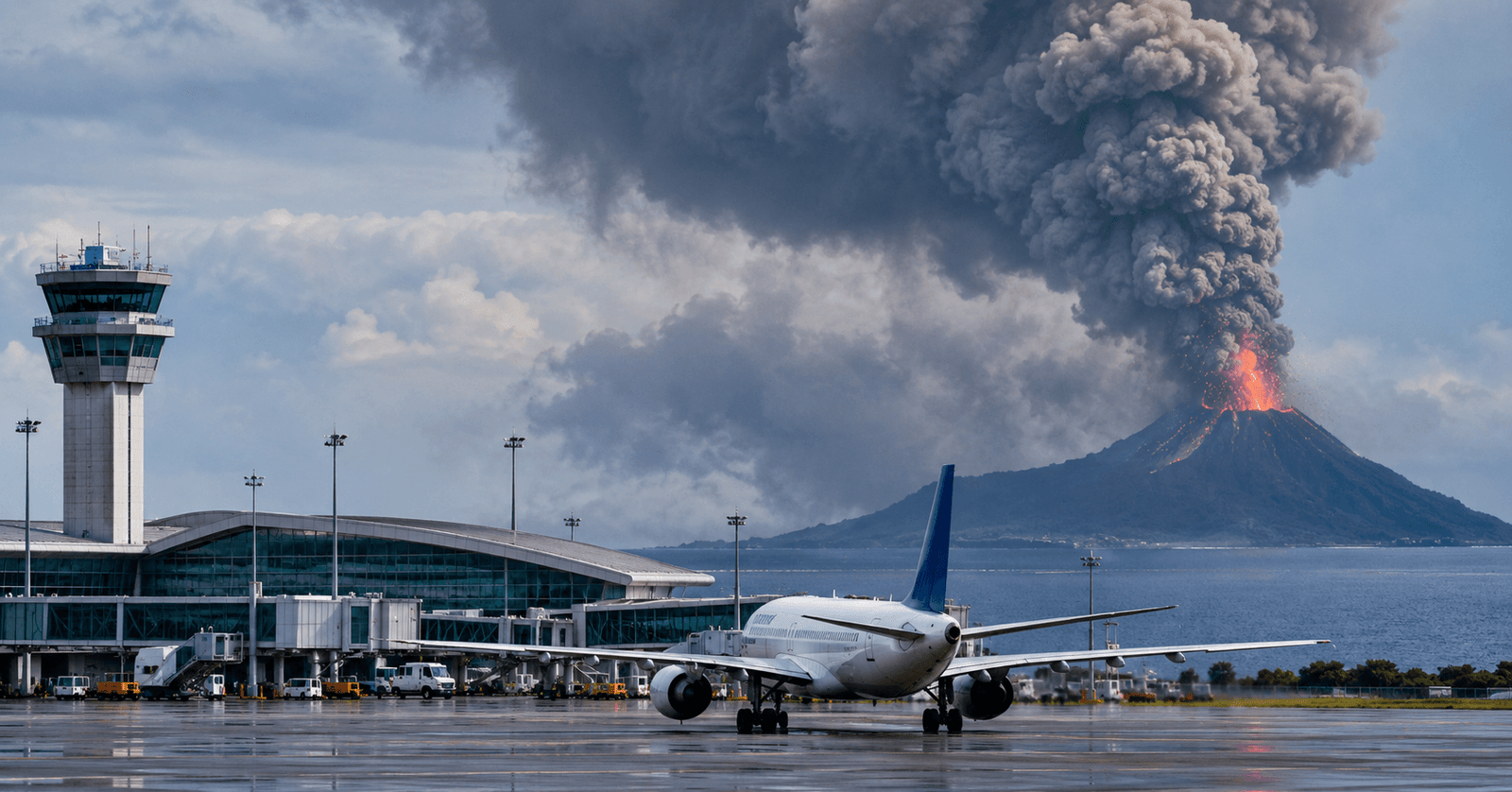

Jakarta’s main international airport and several others across Indonesia have faced extended closures after Mount Anak Krakatau erupted, spewing ash into busy flight paths and stranding hundreds of thousands of travelers.
What Happened?
Anak Krakatau, located roughly 150 kilometers from Jakarta in the strait between Java and Sumatra, began a period of continuous eruption late on Friday, September 4, producing fountains of lava, booming sounds heard up to 700 kilometers away, and ash plumes reaching as high as 50,000 feet in some areas. Eight airports, including Jakarta’s main Soekarno-Hatta International Airport, halted operations over the weekend after ash was detected in their airspace.
Latest Update
As of Monday, September 7, Soekarno-Hatta and six other airports remained closed, with authorities extending the shutdown to give crews time to clean runways, taxiways and aprons, and to let airlines prepare their fleets. Indonesia’s transport ministry reported that more than 270,000 passengers had been affected by the cancellation, delay or diversion of thousands of flights since the eruption began, with some reports citing figures as high as 341,000 affected travelers as the disruption continued into the new week. Schools in Jakarta also moved classes online as a precaution.
Why Is This Trending?
The story is trending because of the scale of disruption to one of Southeast Asia’s busiest travel hubs, the historical significance of the Krakatau volcanic complex, and safety concerns tied to a 2018 tsunami linked to Anak Krakatau that killed hundreds of people.
Key Details
- Volcano: Anak Krakatau (“Child of Krakatau”), about 150 km from Jakarta
- Eruption began: Late Friday, September 4, 2026
- Airports affected: At least eight, including Jakarta’s Soekarno-Hatta International
- Passengers affected: Estimated between roughly 270,000 and 341,000, per Indonesian officials
- Alert level: Level III (“Alert”), Indonesia’s second-highest volcano alert level
- Exclusion zone: A 3-kilometer radius around the crater
Background: What Is Anak Krakatau?
Anak Krakatau, meaning “Child of Krakatau,” emerged from the sea in the early 20th century within the caldera formed by the catastrophic 1883 eruption of Krakatoa, one of the most devastating volcanic events in recorded history. The volcano has remained sporadically active since. In 2018, a partial collapse of Anak Krakatau triggered a tsunami that killed 429 people and displaced thousands, making authorities especially cautious about the current eruption.
What Happens Next?
Indonesian officials say the probability of further eruptions remains high, and airport reopenings depend on ash clearing from flight paths and runways being fully cleaned. Authorities have said there is no imminent tsunami risk from the current activity but have taken precautionary measures, including cloud-seeding efforts to help clear ash from the air.
FAQs
Q: Why is Jakarta’s airport closed?
Volcanic ash from the eruption of Mount Anak Krakatau has been detected in the airspace around Jakarta, prompting safety closures.
Q: How many flights have been affected?
Indonesian officials have reported figures ranging from about 270,000 to 341,000 affected passengers as cancellations and delays continued.
Q: Is there a tsunami risk from this eruption?
Indonesia’s disaster mitigation agency has said there is no imminent tsunami risk from the current eruption, though a 2018 eruption at the same volcano did trigger a deadly tsunami.
Q: Which airport is most affected?
Jakarta’s main Soekarno-Hatta International Airport, along with several other regional airports.
Q: When will Jakarta’s airport reopen?
Reopening depends on ash clearing and runway cleaning; authorities have extended closures multiple times as conditions are reassessed.