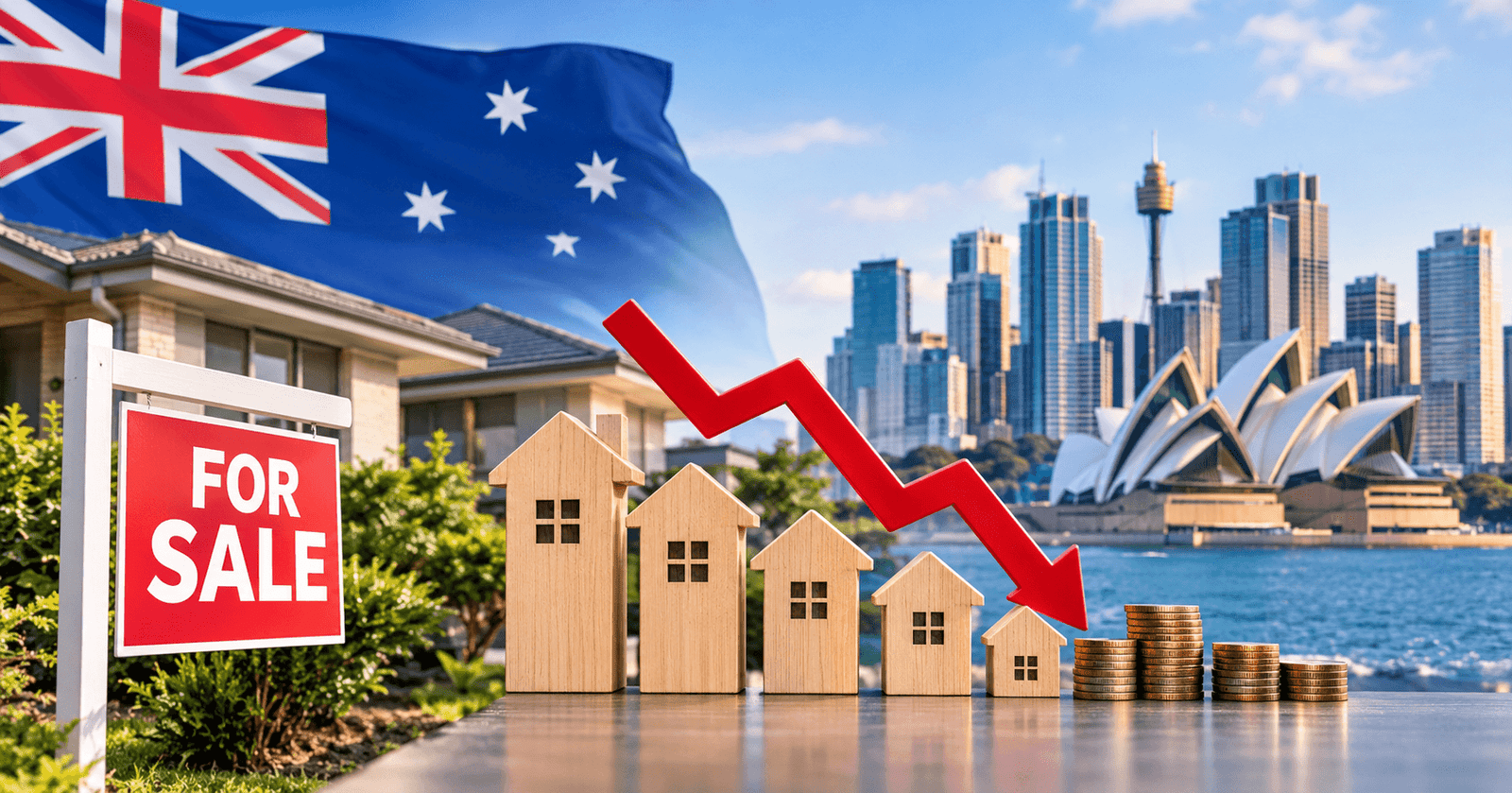

Searches for “real estate bubble” are climbing in Australia as national home prices continue to slide, reviving debate over whether the country’s long-running property boom is finally deflating.
What’s Happening?
Australian home prices fell for a fifth consecutive month in August 2026, dropping 0.2% nationally and sitting about 2.7% below their March 2026 peak, according to market data. Capital-city prices fell 0.3% on average, with Adelaide recording the largest decline at 0.9%, while Darwin was the only capital city to post growth. Higher interest rates, with the cash rate holding at 4.35%, continue to weigh on borrowing capacity and buyer demand.
Latest Update
Major banks, including ANZ, Westpac IQ and CBA, have downgraded their 2026 price growth forecasts, with Westpac IQ now expecting national dwelling prices to stay flat for the calendar year. At the same time, some property analysts argue the current slowdown does not meet the technical definition of a “bubble bursting,” pointing to persistently low housing supply, near-record-low rental vacancy rates, and continued strong population growth as factors keeping a full-blown crash unlikely.
Why Is “Real Estate Bubble” Trending?
The term is trending because falling prices, high household debt, and stretched affordability — with median house prices in cities like Sydney exceeding roughly 10 times the median household income — have reignited public debate over whether Australia is in a genuine housing bubble or a structural undersupply crisis with different dynamics.
Key Details on the Current Market
- National price change: Down 0.2% in August 2026, fifth straight monthly decline
- From peak: About 2.7% below the March 2026 high
- Cash rate: Held at 4.35%
- Weakest capital: Adelaide, down 0.9% in August
- Strongest capital: Darwin, the only capital to record growth (+0.1%)
- Units vs houses: Units rose 3.0% year-on-year, outperforming houses at 1.5%
Why Housing Affordability Became a Crisis
Analysts and researchers point to a combination of factors behind Australia’s stretched affordability: years of undersupply relative to population growth, rising construction costs, tight rental vacancy rates around 1%, and elevated household debt. Some economists argue this reflects a structural housing shortage rather than the classic hallmarks of a bubble, such as oversupply or reckless lending, meaning a sharp nationwide crash is considered unlikely even as prices soften in the short term.
What Happens Next?
Forecasters are divided on the path ahead. Some expect continued softness or flat prices through the rest of 2026, particularly in Sydney and Melbourne, while cities like Perth, Adelaide and Brisbane are still tipped by some forecasters to reach new highs over the medium term, given ongoing supply constraints. Much depends on the Reserve Bank of Australia’s future interest rate decisions.
This article is for general information only and is not personal financial or investment advice.
FAQs
Q: Is Australia’s housing market a bubble?
Experts are divided. Some analysts argue current conditions — low supply, low rental vacancies, strong population growth — don’t match a classic bubble, while others point to high price-to-income ratios as a warning sign.
Q: Are Australian house prices falling in 2026?
Yes, national prices fell for a fifth straight month in August 2026, down about 2.7% from their March peak.
Q: Which Australian city has seen the biggest price drop?
Adelaide recorded the largest capital-city decline in August 2026, down 0.9%.
Q: Is Australia’s cash rate affecting the housing market?
Yes, the Reserve Bank of Australia’s cash rate, held at 4.35%, continues to affect mortgage rates and borrowing capacity.
Q: Will the Australian housing bubble burst?
There’s no consensus. Some analysts see a correction risk in overvalued cities, while others say chronic undersupply makes a sharp nationwide collapse unlikely.