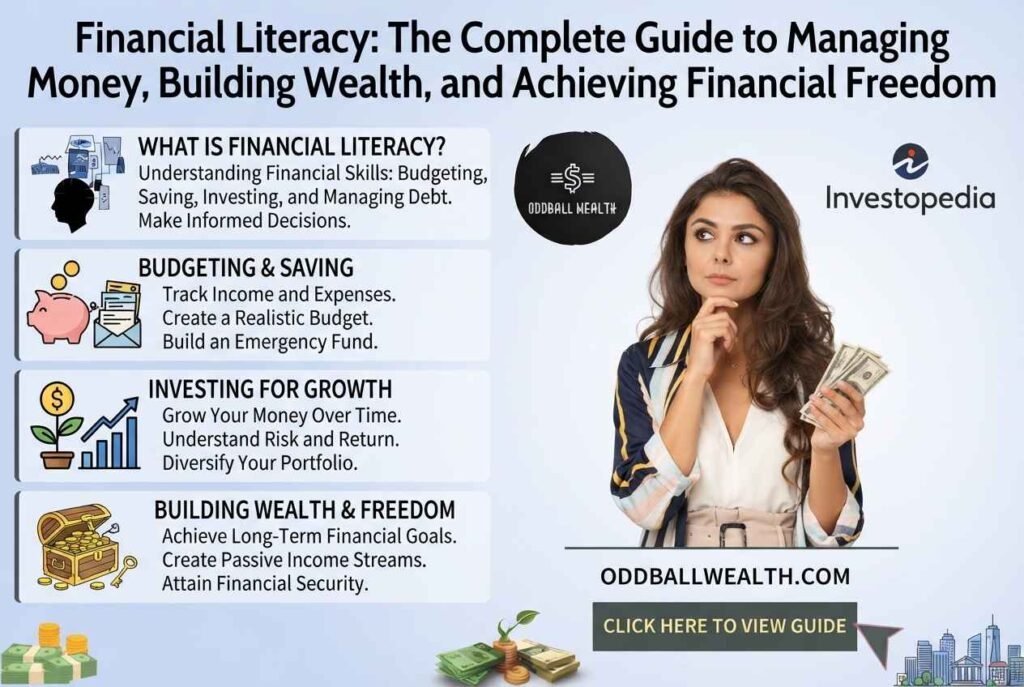
Financial Literacy: The Complete Guide to Managing Money, Building Wealth, and Achieving Financial Freedom

Quick answer: Financial literacy is the ability to understand and apply key money skills, including budgeting, saving, managing debt, investing, and planning for retirement, so you can make confident decisions and build long-term financial security.
Financial literacy is one of the most valuable life skills you can develop, yet most people never learn it in school. Without it, even a high income can disappear into debt, impulse spending, and missed opportunities. With it, even a modest income can grow into real, lasting wealth.
This complete guide explains financial literacy in plain language. You will learn what it means, why it matters, and exactly how to build each skill step by step. Whether you are a student, a young professional, a parent, or someone planning retirement, you will find practical actions you can start today.
Educational disclaimer: This article is for general education only. It is not personalized financial, tax, or legal advice. Consider speaking with a licensed professional about your specific situation.
Key Takeaways
- Financial literacy means understanding how money works and using that knowledge to make smart decisions.
- The core skills are earning, budgeting, saving, borrowing wisely, investing, and protecting what you own.
- A simple budget and a starter emergency fund are the strongest first steps.
- Compound interest rewards those who start early, even with small amounts.
- Financial literacy is a habit, not a one-time lesson. Small consistent actions beat big occasional efforts.
Table of Contents
- What Is Financial Literacy?
- Why Financial Literacy Matters
- The Six Pillars of Financial Literacy
- Budgeting: The Foundation of Money Management
- Saving Money and Building an Emergency Fund
- Understanding Debt and Credit
- Investing Basics for Beginners
- Inflation and Taxes: The Hidden Forces
- Insurance and Risk Protection
- Retirement Planning
- Financial Literacy at Every Life Stage
- How to Spot Scams and Bad Financial Advice
- A 30-Day Financial Literacy Action Plan
- Best Free Financial Literacy Resources
- Common Money Mistakes to Avoid
- Financial Literacy Myths
- Frequently Asked Questions
- Final Thoughts
1. What Is Financial Literacy?
Financial literacy is the knowledge and skill set that allows a person to manage money effectively. According to Investopedia’s definition of financial literacy, it is the possession of the skills and knowledge to make informed and effective decisions with all of your financial resources.
In simple terms, financial literacy answers practical questions such as:
- How much should I spend, and how much should I save?
- What is a good way to pay off debt?
- How do interest rates affect my loans and savings?
- How can I invest safely for the future?
- How do I protect my family if something goes wrong?
Financial literacy is not about being a math genius or a stock market expert. It is about understanding a handful of core ideas and applying them consistently. The good news is that anyone can learn these ideas at any age.
Financial literacy vs. financial education vs. financial capability
These terms are related but not identical.
- Financial education is the process of learning about money, such as taking a class or reading a guide like this one.
- Financial literacy is the resulting knowledge and understanding.
- Financial capability is the ability to actually act on that knowledge, which also depends on access to banking, safe products, and healthy money habits.
The OECD’s financial education programme explains that knowledge alone is not enough. Attitudes and behaviors matter just as much. That is why this guide focuses on habits as well as facts.
2. Why Financial Literacy Matters
Money touches nearly every part of life: housing, health, education, family, and retirement. When people do not understand money, they are more likely to make costly mistakes.
The global literacy gap
Research from the Global Financial Literacy Excellence Center (GFLEC) has consistently shown that only about one in three adults worldwide demonstrates basic financial literacy. This gap exists in both wealthy and developing countries.
Real-life consequences of low financial literacy
People with weaker money skills are more likely to:
- Carry high-interest credit card debt.
- Fall for scams and predatory loans.
- Save too little for emergencies or retirement.
- Avoid investing because it feels confusing or risky.
- Struggle to recover after job loss or medical bills.
The benefits of strong financial literacy
On the other hand, financially literate people tend to:
- Build emergency savings faster.
- Avoid unnecessary interest and fees.
- Make better decisions about homes, education, and careers.
- Feel less stress about money.
- Grow wealth steadily through disciplined investing.
Above all, financial literacy gives you choices. It helps you say yes to opportunities and no to bad deals with confidence.
3. The Six Pillars of Financial Literacy
Every strong financial life rests on six pillars. Master these, and you will cover almost everything that matters.
- Earning – Increasing your income through skills, career growth, or side businesses.
- Spending – Living within your means and spending on what truly matters to you.
- Saving – Setting money aside for emergencies, goals, and the future.
- Borrowing – Using credit and loans wisely, and avoiding destructive debt.
- Investing – Growing your money over time through assets like stocks, bonds, and funds.
- Protecting – Safeguarding your wealth with insurance, legal planning, and fraud awareness.
The rest of this guide walks through each pillar in detail.
4. Budgeting: The Foundation of Money Management
A budget is simply a plan for your money. It tells every dollar, rupee, or euro where to go before the month begins. Budgeting is the most important first step in financial literacy because everything else depends on knowing where your money goes.
Step-by-step: how to create a budget
- Calculate your monthly income. Include your salary after tax, side income, and any other regular earnings.
- List your fixed expenses. These include rent, loan payments, insurance, and subscriptions.
- Estimate your variable expenses. These include food, transport, utilities, and entertainment.
- Set savings and debt goals. Decide how much you want to save and pay toward debt each month.
- Track your spending. Use a notebook, spreadsheet, or budgeting app for at least 30 days.
- Review and adjust. Compare your plan with reality and make changes every month.
Popular budgeting methods
The 50/30/20 rule. This simple framework divides after-tax income into three groups:
- 50% for needs: housing, food, transport, utilities, and minimum debt payments.
- 30% for wants: dining out, hobbies, travel, and entertainment.
- 20% for savings and extra debt payments.
Consumer finance publishers such as NerdWallet popularized this approach because it is easy to remember and flexible. If your needs cost more than 50% in an expensive city, adjust the percentages to fit your reality.
Zero-based budgeting. Here, income minus expenses, savings, and debt payments equals exactly zero. Every unit of money gets a job. This method works well for people who want tight control.
The envelope method. You place cash for each spending category into a separate envelope. When an envelope is empty, spending in that category stops. Digital versions of this method are available in many budgeting apps.
Pay yourself first. You automatically move savings out of your paycheck as soon as it arrives. You then spend what remains. This method is powerful because it removes willpower from the equation.
Budgeting tips that actually work
- Automate savings and bill payments so nothing gets missed.
- Review subscriptions every quarter and cancel what you do not use.
- Give yourself a small “fun money” allowance to prevent burnout.
- Use the 24-hour rule for non-essential purchases. Wait a day before buying.
- Plan for irregular expenses such as annual insurance, gifts, and repairs.
5. Saving Money and Building an Emergency Fund
Saving is the bridge between earning money and building wealth. It protects you from surprises and funds your future goals.
Why an emergency fund comes first
An emergency fund is money set aside for unexpected events such as job loss, medical bills, or urgent repairs. Without one, a single surprise can push you into high-interest debt.
Financial educators commonly recommend saving three to six months of essential living expenses. As explained by NerdWallet’s guide on why emergency funds matter, this cushion gives you time to recover without borrowing.
How to build your emergency fund step by step
- Start small. Aim first for one month of expenses or a small starter amount.
- Automate transfers. Send a fixed amount to a separate savings account each payday.
- Keep it separate. Use a different account so you are not tempted to spend it.
- Choose an accessible, safe place. A high-yield savings account or similar low-risk option works well.
- Refill it after use. Treat the fund as a rolling safety net.
Saving for short-term, medium-term, and long-term goals
- Short-term (under 1 year): vacations, gadgets, small repairs. Keep the money in savings.
- Medium-term (1 to 5 years): a car, wedding, or house down payment. Use low-risk options.
- Long-term (5+ years): retirement, children’s education, financial independence. Invest for growth.
Matching your savings vehicle to your time horizon is a core financial literacy skill.
6. Understanding Debt and Credit
Debt is a tool. Used wisely, it can help you buy a home or start a business. Used carelessly, it can trap you for years.
Good debt vs. bad debt
- Potentially good debt helps you build long-term value, such as an affordable mortgage, education that increases earning power, or a business loan with a solid plan.
- Bad debt finances things that lose value quickly or carries very high interest, such as unpaid credit card balances, payday loans, and impulse purchases on installment plans.
How interest works
Interest is the cost of borrowing money. The higher the interest rate and the longer the loan, the more you pay. Always compare the annual percentage rate (APR), not just the monthly payment. Read all fees before you sign.
Two proven debt payoff strategies
Debt snowball. List debts from smallest balance to largest. Pay minimums on all, and throw extra money at the smallest one. When it is cleared, roll that payment into the next. This method builds motivation through quick wins.
Debt avalanche. List debts from highest interest rate to lowest. Focus extra payments on the highest-rate debt first. This method usually saves the most money in interest.
Choose the method you will actually stick with. Consistency matters more than perfection.
Credit scores and credit reports
A credit score is a number that summarizes how reliably you repay debt. Lenders use it to decide whether to approve you and at what interest rate. Common factors include:
- Payment history – paying on time is the biggest factor.
- Credit utilization – keep balances well below your limits. Many experts suggest staying under about 30%.
- Length of credit history – older accounts help.
- New credit applications – too many inquiries in a short time can lower your score.
- Credit mix – a healthy blend of credit types can help.
In the United States, you can check your reports for free through AnnualCreditReport.com, the official source authorized by federal law. Review them regularly for errors or signs of identity theft. If you live elsewhere, look for the official credit bureau or central bank service in your country.
Debt red flags
Watch out for these warning signs:
- You only pay the minimum on credit cards.
- You borrow to pay other debts.
- You avoid opening bills or checking balances.
- You use payday or cash-advance loans regularly.
If you notice these patterns, act early. Contact lenders, build a repayment plan, and consider free credit counseling from a reputable nonprofit.
7. Investing Basics for Beginners
Saving protects your money. Investing grows it. Because of inflation, money sitting idle loses purchasing power over time, so long-term goals usually require investing.
The power of compound interest
Compound interest means you earn returns on your original money and on the returns you already earned. Over decades, this snowball effect becomes enormous.
Consider a simple example. Suppose you invest $200 per month and earn an average annual return of 7% (a hypothetical figure for illustration, not a guarantee):
- After 10 years, you would have roughly $34,000.
- After 20 years, roughly $104,000.
- After 30 years, roughly $244,000, even though you contributed only $72,000 of your own money.
Time is the most powerful ingredient. Starting ten years earlier can be worth more than doubling your monthly contribution later. You can experiment with your own numbers using the SEC’s free compound interest calculator on Investor.gov.
The Rule of 72
The Rule of 72 is a quick mental shortcut. Divide 72 by your expected annual return to estimate how many years it takes to double your money. At 8%, money doubles in about nine years (72 ÷ 8 = 9). The same rule works in reverse for inflation and debt.
Common investment types
- Stocks represent ownership in a company. They offer higher growth potential with higher short-term risk.
- Bonds are loans to governments or companies that pay interest. They are typically steadier than stocks.
- Mutual funds pool money from many investors to buy a mix of assets.
- Exchange-traded funds (ETFs) are baskets of investments that trade like stocks, often with low fees.
- Real estate can produce rental income and long-term appreciation, but it requires larger capital and management.
- Retirement accounts offer tax advantages in many countries and are a smart home for long-term investing.
Key investing principles
- Diversify. Spreading money across many assets reduces the damage if one fails.
- Think long-term. Markets rise and fall. Time in the market usually matters more than timing the market.
- Watch fees. Even small annual fees can consume a large share of returns over decades.
- Match risk to your goals. Money needed in two years should not sit in volatile assets.
- Invest regularly. Investing a fixed amount on a schedule, often called dollar-cost averaging, smooths out market swings.
- Never invest money you cannot afford to lose. Cover your emergency fund and high-interest debt first.
For unbiased education, the SEC’s Investor.gov and FINRA’s investor education pages offer free, plain-language guides. Large providers such as the Fidelity Learning Center also publish beginner tutorials.
Understanding risk tolerance
Risk tolerance is how much ups and downs you can handle emotionally and financially. A young investor with decades ahead can usually accept more volatility. Someone near retirement often prefers stability. Be honest with yourself, because panic selling during a downturn is one of the most common investing mistakes.
8. Inflation and Taxes: The Hidden Forces
Two invisible forces quietly shape your financial results: inflation and taxes.
What is inflation?
Inflation is the gradual rise in prices over time. It reduces what each unit of money can buy. Using the Rule of 72, at 3% inflation the purchasing power of cash roughly halves in 24 years (72 ÷ 3 = 24).
That is why keeping all your money in low-interest accounts for decades can quietly cost you. Your savings may grow in number but shrink in real value. Understanding real returns, which equal your return minus inflation, is a hallmark of financial literacy.
Why taxes matter
Taxes reduce your income, investment gains, and sometimes your wealth. Understanding basic tax concepts helps you keep more of what you earn legally.
- Learn the difference between gross income and net income.
- Know which expenses, credits, or deductions apply in your country.
- Use tax-advantaged retirement or savings accounts when available.
- Keep organized records throughout the year.
- File on time to avoid penalties.
For official tax guidance in the United States, visit the IRS website. In Pakistan, the Federal Board of Revenue (FBR) provides local tax information. Always follow the rules in your own country.
9. Insurance and Risk Protection
Building wealth is only half the job. Protecting it is the other half. Insurance transfers the risk of large, unpredictable losses to a company in exchange for a regular premium.
Common types of insurance
- Health insurance protects against expensive medical bills.
- Life insurance supports dependents if the policyholder passes away.
- Disability or income protection replaces income if you cannot work.
- Home or renters insurance covers property damage and theft.
- Vehicle insurance covers accidents and liability.
Smart insurance habits
- Insure against losses you could not afford, not small everyday costs.
- Compare quotes and read the exclusions carefully.
- Avoid mixing insurance with investments unless you fully understand the fees.
- Review coverage after major life events such as marriage, a new child, or a new home.
A basic will, clear beneficiary designations, and organized documents also form part of financial protection.
10. Retirement Planning
Retirement can last 20 to 30 years or more. Your paycheck will stop, but your expenses will not. Planning early is the single best way to enjoy that stage comfortably.
Steps to plan for retirement
- Estimate your future needs. Many planners suggest aiming for roughly 70% to 80% of your pre-retirement spending, though your lifestyle matters.
- Start now. Thanks to compounding, early small contributions often beat late large ones.
- Use workplace or government schemes. If your employer matches contributions, capture the full match because it is effectively free money.
- Use tax-advantaged accounts. Look for the options available in your country.
- Diversify. Blend growth assets and stable assets, and gradually reduce risk as retirement approaches.
- Review yearly. Adjust contributions when your income rises.
Sources of retirement income
Depending on your country, retirement income can come from pensions, retirement accounts, personal investments, rental income, and part-time work. Relying on a single source is risky, so aim for several.
11. Financial Literacy at Every Life Stage
Money lessons change with age. Here is what to focus on at each stage.
For children and teens
- Teach the difference between needs and wants.
- Give a small allowance and let them practice saving and spending.
- Open a youth savings account when possible.
- Use games and everyday experiences, like grocery shopping, to teach prices and budgeting.
- Explain that money is earned through effort and value.
The FDIC’s Money Smart program offers free lessons for young people and adults.
For college students and young adults
- Understand student loan terms before borrowing.
- Build a habit of tracking expenses from your first paycheck.
- Establish a credit history responsibly with on-time payments.
- Start an emergency fund, even if it is tiny.
- Begin investing small amounts early to benefit from compounding.
- Consider building a side income with skills such as freelancing or tutoring.
For families
- Create a shared household budget and hold monthly money meetings.
- Save for education, housing, and health costs.
- Review insurance coverage and estate basics.
- Model healthy money behavior for children.
For people approaching retirement
- Estimate expenses and income sources in detail.
- Reduce debt before leaving work.
- Shift gradually toward more stable investments.
- Plan for healthcare costs and long-term care.
- Consider how to make your savings last, including withdrawal strategies.
For women and underserved groups
Women often face career interruptions, longer lifespans, and lower average retirement savings in many countries. Building independent financial skills, holding personal accounts, and planning for the long term are especially important. Global institutions such as the World Bank’s financial inclusion resources highlight the importance of equal access to financial tools.
12. How to Spot Scams and Bad Financial Advice
Financial literacy includes knowing how to protect yourself from fraud. Scammers target both beginners and experienced people.
Warning signs of a scam
- Guaranteed high returns with no risk. Real investments always carry risk.
- Pressure to act immediately. Scammers create false urgency.
- Requests for gift cards, cryptocurrency, or wire transfers. These are hard to trace.
- Unsolicited contact by phone, email, or social media promising easy money.
- Vague explanations of how the profit is generated.
- Pyramid or multi-level schemes that reward recruiting more than selling real products.
Ways to protect yourself
- Verify licenses and registrations with your national regulator.
- Never share passwords, PINs, or one-time codes.
- Enable two-factor authentication on financial accounts.
- Research independently before investing. Do not rely only on social media influencers.
- Trust your instincts. If it sounds too good to be true, it probably is.
The U.S. Federal Trade Commission publishes up-to-date consumer alerts, and the Consumer Financial Protection Bureau offers free tools and complaint services. If you live in Pakistan, check with the Securities and Exchange Commission of Pakistan (SECP) and the State Bank of Pakistan (SBP) for regulated institutions and consumer awareness material.
13. A 30-Day Financial Literacy Action Plan
Knowledge without action changes nothing. Use this simple plan to turn what you have learned into results.
Week 1: Get clear
- Write down all sources of income.
- List every debt with its balance and interest rate.
- Track every expense for seven days.
- Check your bank and credit accounts for accuracy.
Week 2: Build the system
- Create your first monthly budget using the 50/30/20 rule or another method.
- Open a separate savings account for your emergency fund.
- Set up an automatic transfer, even a small one.
- Cancel at least one unused subscription.
Week 3: Reduce risk
- Choose a debt payoff strategy (snowball or avalanche).
- Review your insurance coverage.
- Enable two-factor authentication on key accounts.
- Write down three financial goals: short, medium, and long term.
Week 4: Start growing
- Learn the basics of one investment type, such as low-cost index funds or your country’s retirement scheme.
- Open an investment or retirement account if you are ready and have covered your basics.
- Schedule a monthly 30-minute “money date” to review progress.
- Pick one new financial book, podcast, or course to continue learning.
After 30 days, you will have a working system. Improve it every month.
14. Best Free Financial Literacy Resources
You do not need to pay for quality education. These reputable, free resources can take you far:
- Khan Academy Personal Finance – free video lessons on budgeting, credit, and investing.
- Investor.gov – investor education from the U.S. Securities and Exchange Commission.
- Consumer Financial Protection Bureau – guides and tools on loans, credit, and banking.
- FDIC Money Smart – free courses for all ages.
- FINRA Investor Education – tools for understanding investing and avoiding fraud.
- Investopedia – a large, searchable dictionary and library of finance topics.
- OECD Financial Education – global policy and research on financial literacy.
- State Bank of Pakistan – consumer protection and financial literacy material for readers in Pakistan.
Books worth reading
- The Psychology of Money by Morgan Housel
- The Simple Path to Wealth by JL Collins
- Your Money or Your Life by Vicki Robin and Joe Dominguez
- I Will Teach You to Be Rich by Ramit Sethi
- The Intelligent Investor by Benjamin Graham
15. Common Money Mistakes to Avoid
Even smart people repeat these errors. Awareness is the first step to avoiding them.
- Living without a budget. Without a plan, money disappears.
- Skipping the emergency fund. One surprise can start a debt spiral.
- Carrying high-interest debt. Interest quietly drains your progress.
- Lifestyle inflation. Spending more every time income rises keeps you stuck.
- Waiting to invest. Delay costs you compounding years.
- Chasing get-rich-quick schemes. They usually enrich the promoters, not you.
- Investing without understanding. Never buy what you cannot explain.
- Ignoring insurance. One major loss can erase years of savings.
- Comparing yourself to others. Social media rarely shows real finances.
- Not talking about money. Silence keeps people uninformed and stressed.
16. Financial Literacy Myths
Myth 1: “I need a high income to build wealth.” Habits matter more than income. Many high earners live paycheck to paycheck, while consistent savers with average incomes build wealth over time.
Myth 2: “Investing is only for rich people.” Many platforms allow you to start with small amounts, and low-cost funds make diversification affordable.
Myth 3: “All debt is bad.” Some debt can be useful, but it must be affordable, purposeful, and manageable.
Myth 4: “I’m too old (or too young) to start.” The best time to start is now. Older learners can still improve retirement outcomes, and younger learners gain the advantage of time.
Myth 5: “Budgeting means never having fun.” A good budget includes room for enjoyment. It simply makes your spending intentional.
Myth 6: “Financial literacy is too complicated.” The basics are simple. Complexity comes later, and you can learn it gradually.
17. Frequently Asked Questions About Financial Literacy
What is financial literacy in simple words?
Financial literacy is knowing how money works and using that knowledge to budget, save, borrow, invest, and protect yourself wisely.
Why is financial literacy important?
Financial literacy helps you avoid debt traps, build savings, invest for the future, and reduce money-related stress. It also protects you from scams and poor financial decisions.
What are the main components of financial literacy?
The main components are earning, spending, saving, borrowing, investing, and protecting your assets through insurance and planning.
How can I improve my financial literacy?
Start by tracking your spending, creating a budget, and building an emergency fund. Then learn about debt, credit, and investing through trusted, free resources, and review your progress monthly.
At what age should you start learning about money?
Children can learn basic ideas like saving and the difference between needs and wants from a young age. Formal budgeting, credit, and investing skills are ideal to learn in the teenage and early adult years, but it is never too late to start.
What is the 50/30/20 rule?
The 50/30/20 rule divides after-tax income into 50% needs, 30% wants, and 20% savings and debt repayment. It is a simple starting framework you can adjust to your situation.
How much should I have in an emergency fund?
Most financial educators recommend three to six months of essential living expenses. If your income is irregular or you support dependents, consider aiming for the higher end.
What is the best way to start investing with little money?
Begin by covering your emergency fund and high-interest debt. Then consider low-cost, diversified options such as index funds or your country’s retirement schemes, and invest small amounts regularly.
Is financial literacy taught in schools?
In many countries, financial education is limited or optional. That is why self-education through reliable online and community resources is so important.
Can financial literacy make me rich?
Financial literacy does not guarantee wealth, but it greatly improves your chances of building long-term financial security. It gives you the skills to make smart decisions, avoid costly mistakes, and let time and compounding work in your favor.
Financial literacy is not a luxury. It is a survival skill and a freedom skill. It empowers you to handle emergencies, seize opportunities, support your family, and retire with dignity.
You do not need to master everything at once. Start with one small step today: track your spending, open a savings account, or read one chapter of a good money book. Then repeat the process consistently.
Remember the core formula: spend less than you earn, save automatically, avoid bad debt, invest for the long term, and protect what you build. Practice it for years, and the results will surprise you.
The best time to improve your financial literacy was yesterday. The second best time is right now.