Nepal-Tibet Flash Floods: Death Toll Tops 900 as Rescuers Search Hydropower Tunnels

Nearly a week after catastrophic flooding tore through Himalayan river valleys, international rescue teams are racing to reach hundreds of workers feared trapped inside collapsed hydropower tunnels on the Nepal-China border.
A catastrophic wall of water, mud and rock tore through riverside communities in Nepal and Tibet last week, and rescue crews are still working nearly seven days later to locate hundreds of people who remain missing. The flooding, which struck the Rasuwa and Nuwakot districts of Nepal and the Tibet Autonomous Region of China, has killed more than 900 people and left thousands more unaccounted for.
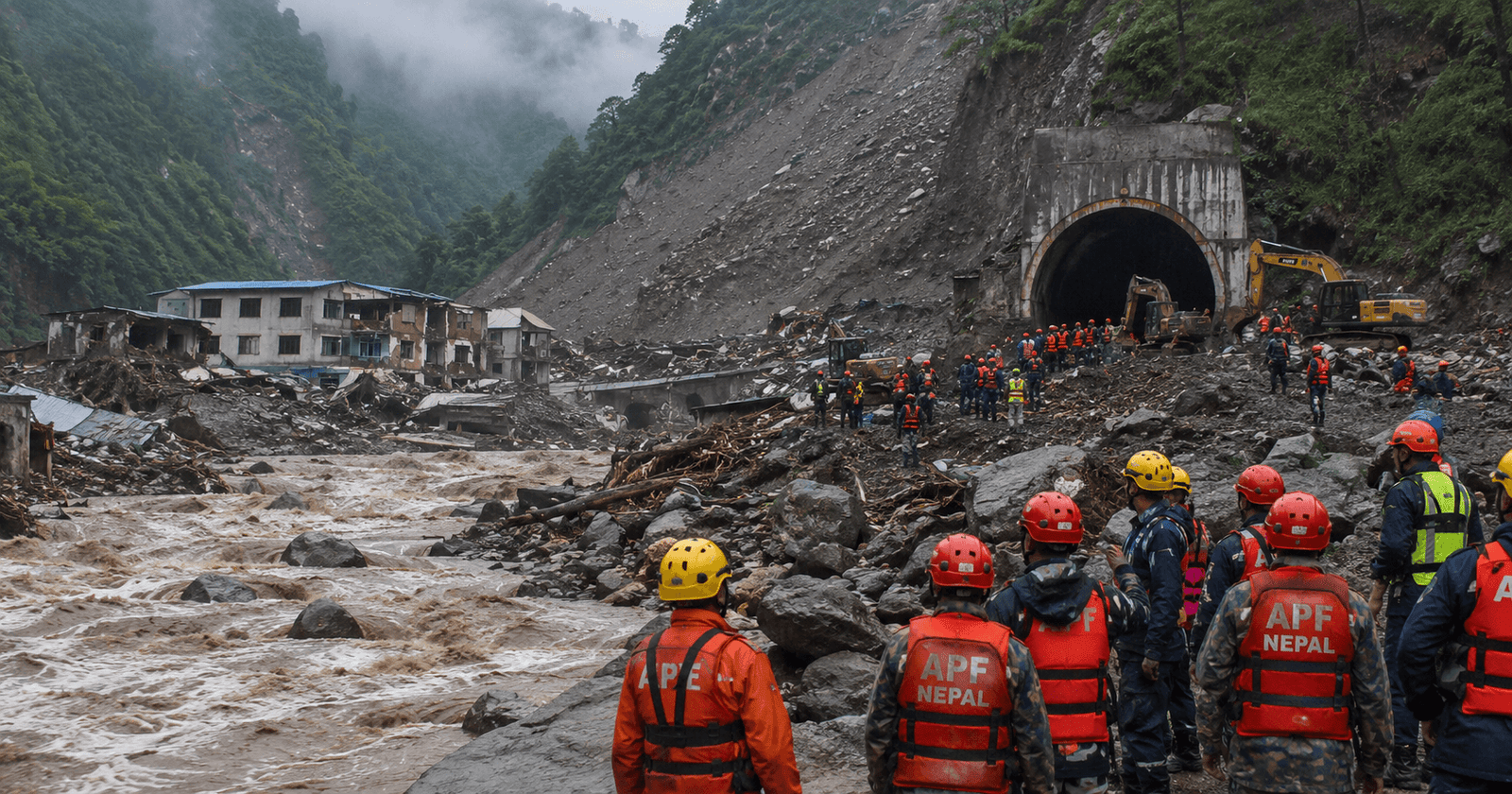
Much of the current rescue effort is focused on a dozen or more hydropower project sites along the Trishuli River, where workers are believed to be trapped inside deep tunnels that were buried when the floodwaters hit.
WHAT HAPPENED?
The disaster began last Wednesday, when intense monsoon rainfall combined with what officials believe was a glacial or landslide-triggered outburst to send a massive surge of water, mud and debris down river valleys spanning the Nepal-China border. Entire settlements along the Trishuli and neighboring rivers were swept away within minutes.
According to Nepal’s disaster management agency, at least 903 deaths had been confirmed in the country by Monday, with more than 4,200 people still listed as missing, including nearly 600 foreign nationals. On the Chinese side, in the Tibet Autonomous Region, authorities reported at least 16 confirmed deaths and around 546 people missing, more than a hundred of whom were reported to be Nepali citizens.
Rescue operations have since shifted toward a highly technical and dangerous phase: digging into buried hydropower tunnels where large groups of construction workers were on shift when the flood struck. Mohan Kumar Dangi, president of Nepal’s Independent Power Producers Association, said the floods damaged at least a dozen hydropower projects across the two districts, with roughly 900 workers unaccounted for from those sites alone. A large share of those missing workers, close to 600 people, were reportedly working at the Upper Trishuli-1 project, which was still under construction in Rasuwa district.
WHAT OFFICIALS / SOURCES ARE SAYING
Nepal’s Minister of Energy, Water Resources and Irrigation, Biraj Bhakta Shrestha, described the search for trapped hydropower workers as the government’s highest priority, noting that crews were working to drill into sealed tunnel sections at two major project sites in Rasuwa.
International specialists have also joined the effort. An Australian tunnel-rescue expert who has advised on the operation described the unusual nature of this rescue: the tunnels themselves largely held together, but everything surrounding their entrances collapsed, complicating access.
Survivors who escaped the flooded sites have described chaotic and desperate scenes. One worker who made it out estimated that only a small fraction of roughly 1,000 people at his and nearby project sites had emerged safely. According to Nepal’s prime minister, more than 11,000 people have been rescued nationwide since the flooding began.
On the Chinese side, state broadcasters have shown crews working around the clock to rebuild a key border road connecting to the Gyirong Port crossing, which was left submerged under several metres of water.
KEY FACTS
- Location: Rasuwa and Nuwakot districts, Nepal, and the Tibet Autonomous Region, China
- Date: Flooding began roughly one week before September 1, 2026
- People affected: Confirmed deaths above 900 in Nepal and at least 16 in Tibet; more than 4,700 people missing across both countries
- Official response: Multinational rescue teams deployed; drilling operations underway at buried hydropower tunnels; over 11,000 people rescued nationwide in Nepal
- Latest development: Search efforts remain concentrated on a dozen or more hydropower sites, with hundreds of workers still unaccounted for
WHY THIS MATTERS
This disaster is one of the deadliest flooding events to hit the Himalayan region in decades, with a death toll and missing-persons count that continues to climb. Beyond the immediate humanitarian toll, the flooding has knocked out hydropower infrastructure that supplies electricity to tens of thousands of people, raising concerns about longer-term energy shortages in affected districts.
The disaster also has cross-border implications, requiring coordination between Nepali and Chinese authorities on search-and-rescue logistics, missing-persons lists that include citizens of both countries, and infrastructure repair along a shared and economically important trade corridor.
BACKGROUND
Nepal’s monsoon season regularly brings landslides and flash flooding to its steep Himalayan valleys, but this event has been described by officials and outside experts as catastrophic in scale, far exceeding a typical seasonal flood. The hydropower sector, a major part of Nepal’s energy and export economy, has been especially hard-hit because many project sites and worker camps are built directly along the riverbanks that were inundated.
WHAT HAPPENS NEXT?
Rescue and drilling operations at the buried tunnel sites are expected to continue in the coming days as crews try to reach any survivors who may still be alive in air pockets within the tunnel systems. Nepali officials are also expected to continue updating official death and missing-persons tolls as recovery work progresses, and questions are likely to be raised about whether future hydropower projects should be sited differently to reduce flood exposure.
LATEST UPDATE
As of the most recent reports, search and rescue teams remain engaged in what officials have called a race against time to reach workers trapped inside hydropower tunnels, and the situation continues to develop as the confirmed death toll and missing-persons figures are updated.
This is a sensitive and ongoing humanitarian story. If you or someone you know has been affected by disaster-related grief or trauma, consider reaching out to a local counseling or crisis support service.