
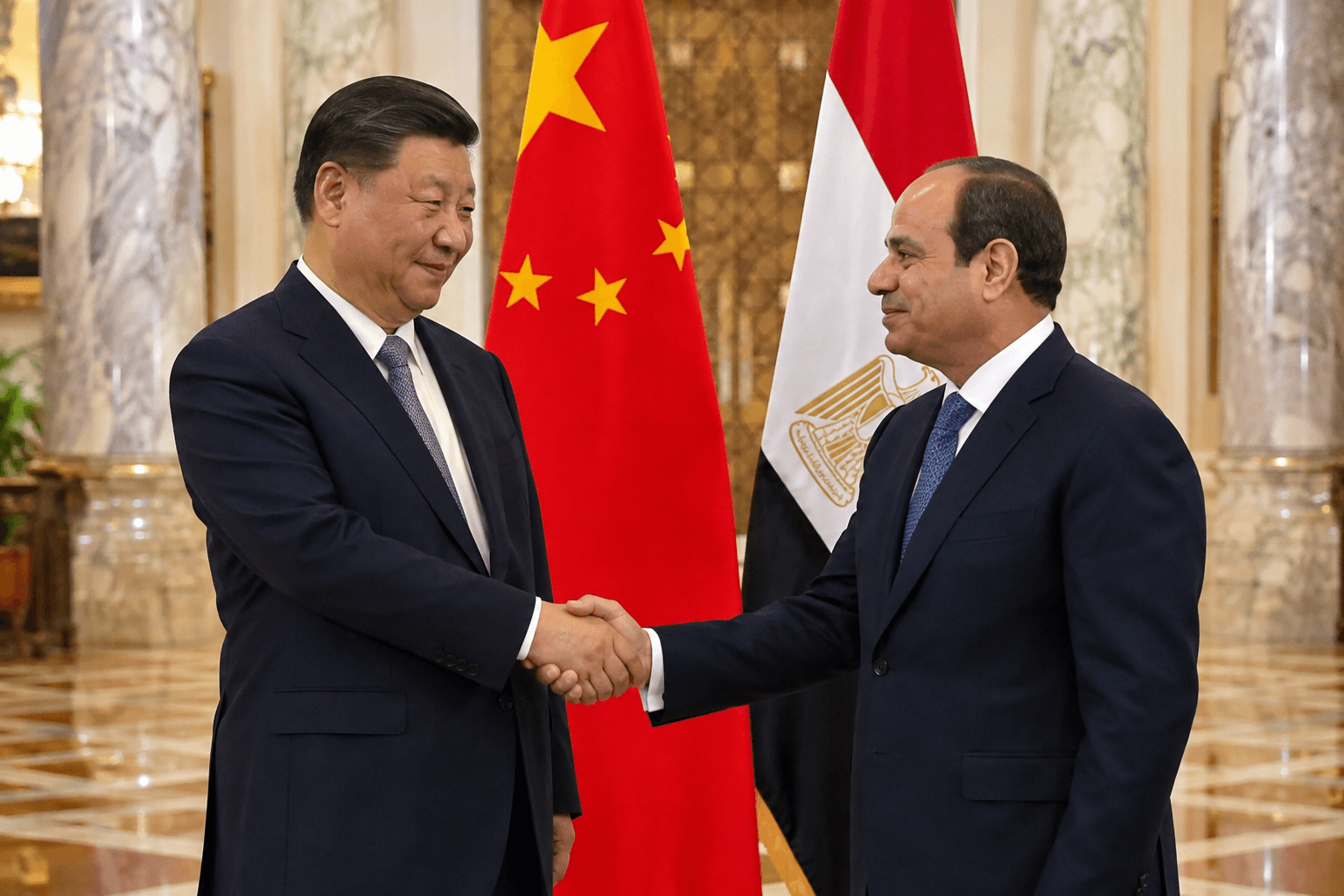

The Chinese leader’s three-day trip to Cairo comes as the ongoing US-Iran war pushes Washington’s traditional Middle East allies to widen their strategic options.
Chinese President Xi Jinping has completed a three-day visit to Egypt, his first trip to the country in a decade, as Beijing works to deepen its economic and diplomatic footprint in a region long dominated by US influence. Xi was welcomed in Cairo by Egyptian President Abdel Fattah el-Sissi in a ceremony marking 70 years of diplomatic relations between the two nations.
The visit is widely seen as more than a routine diplomatic exchange. It comes as the six-month war between the United States, Israel and Iran has strained Washington’s standing with regional partners, giving China an opening to position itself as an alternative economic and security partner.
WHAT HAPPENED?
Xi arrived in Cairo on September 1 to a formal welcome that included a red-carpet reception, a military salute and cultural performances. Egypt made China’s leader its only Middle East stop on this trip, underscoring what Egyptian officials describe as Cairo’s role as a regional “linchpin” for Beijing’s ambitions.
Both leaders published opinion pieces in Egyptian state newspapers to mark the anniversary of diplomatic relations. Xi wrote that China and Egypt should “expand the scope of pragmatic collaboration,” while el-Sissi praised Chinese investment and reaffirmed Egypt’s support for China’s position that Taiwan is part of its territory.
According to Egypt’s Central Agency for Public Mobilisation and Statistics, Egyptian exports to China nearly tripled in the first half of 2026 compared with the previous year, reaching roughly $840 million, while imports from China stood at about $10.4 billion. Chinese investment is concentrated around the Suez Canal economic zone, including the TEDA cooperation area in Ain Sokhna, which state media says hosts around 200 companies with investments exceeding $3.8 billion.
WHAT OFFICIALS / SOURCES ARE SAYING
Egyptian presidential spokesman Mohamed el-Shennawy said the visit was intended to strengthen bilateral relations and advance an existing Comprehensive Strategic Partnership Agreement between the two countries.
Retired Egyptian Major General Samir Farag told NPR that China views Egypt as a gateway to Africa, allowing Beijing to manufacture goods locally and make use of the Suez Canal for trade with Europe.
Analysts cited by Al Jazeera and NPR noted that the trip allows Xi to portray China as a regional stabilizer, in contrast with what he depicts as prolonged US military entanglement in the Middle East.
KEY FACTS
- Location: Cairo, Egypt
- Date: September 1–3, 2026 (three-day visit)
- Occasion: 70th anniversary of China-Egypt diplomatic relations
- Trade data: Egyptian exports to China up nearly 200% in H1 2026, reaching about $840.8 million; imports about $10.4 billion
- Investment hub: China-Egypt TEDA zone in Ain Sokhna hosts roughly 200 companies with over $3.8 billion invested
WHY THIS MATTERS
The visit illustrates how the prolonged Iran war is reshaping alliances across the Middle East. As US military resources remain tied up in the Gulf conflict, regional powers such as Egypt are diversifying their partnerships rather than relying solely on Washington. For China, deepening ties with Egypt — the most populous Arab nation and custodian of the Suez Canal — offers both economic opportunity and geopolitical leverage in a region critical to global trade routes.
BACKGROUND
Egypt and China established diplomatic relations 70 years ago, and President el-Sissi has visited China multiple times since taking office in 2014. Xi’s last visit to Egypt came a decade ago, and his most recent trip to the wider Middle East before this one was to Saudi Arabia in 2022. Ties between Cairo and Beijing have grown steadily through Belt and Road Initiative projects, particularly around the Suez Canal corridor, even as Egypt has maintained its long-standing security relationship with the United States.
WHAT HAPPENS NEXT?
Officials from both countries are expected to follow up on new economic agreements and technology cooperation, including in artificial intelligence, building on the momentum from this visit. Analysts expect Egypt to continue balancing its relationships with both Washington and Beijing as regional instability from the Iran war persists.
LATEST UPDATE
Xi’s Egypt visit concluded this week, with both governments describing the trip as a milestone in bilateral relations. Further announcements on specific trade or investment agreements may follow in the coming weeks.