
Financial Planning: The Complete Beginner’s Guide to Building a Plan That Lasts

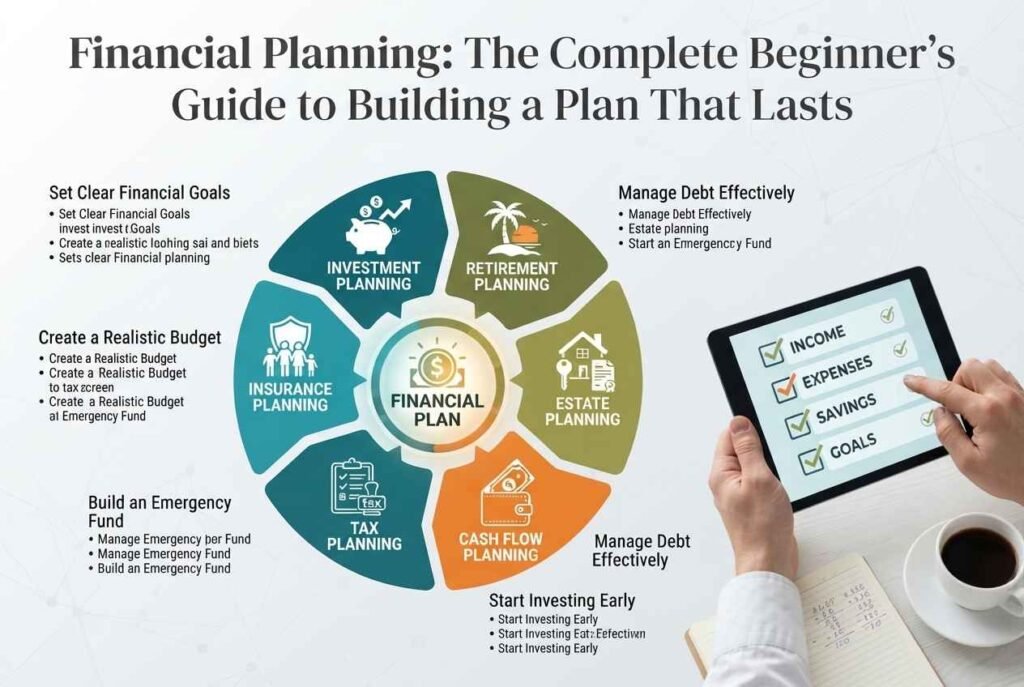
Financial planning is the process of setting money goals, measuring where you stand today, and building a step-by-step roadmap to reach those goals through budgeting, saving, investing, insurance, tax planning, and retirement planning. Done well, a financial plan replaces money stress with clarity. This guide walks you through every stage in plain language, with trusted tools and official resources linked along the way.
Disclaimer: This article is for general education only and is not personalized financial, tax, or legal advice. Rules, limits, and rates change, so always confirm current figures with official sources or a licensed professional.
Key Takeaways
- Financial planning means defining goals, tracking your net worth and cash flow, and following a written plan for saving, investing, protecting, and retiring.
- A solid plan has seven pillars: budgeting, emergency savings, debt management, investing, insurance, tax planning, and estate planning.
- Start with a starter emergency fund, then attack high-interest debt, then invest consistently for the long term.
- Review your plan at least once a year and after any major life event such as marriage, a new child, a job change, or a home purchase.
- You can build a plan yourself with free tools, or hire a fiduciary financial planner for personalized guidance.
What Is Financial Planning?
Financial planning is a structured approach to managing your money so that your everyday decisions support your long-term goals. According to Investopedia’s definition of financial planning, it is a comprehensive evaluation of an individual’s current and future financial state, using known variables to predict future income, asset values, and withdrawal plans.
In simple terms, financial planning answers four questions:
- Where am I now? (income, spending, assets, debts, net worth)
- Where do I want to be? (goals such as a home, education, retirement, or a business)
- How do I get there? (savings targets, investment mix, insurance, tax strategy)
- How do I stay on track? (regular reviews and adjustments)
A financial plan is not the same as a budget. A budget tracks monthly cash flow. A financial plan is bigger: it includes your budget but also covers investing, protection, taxes, and legacy. Think of a budget as a single tool and financial planning as the whole toolbox.
Financial Planning vs. Personal Finance vs. Financial Advice
People often use these terms interchangeably, but they are different:
- Personal finance is the broad topic of how individuals manage money day to day.
- Financial planning is the organized, goal-based process of designing and following a money roadmap.
- Financial advice is a recommendation from a professional about a specific decision, such as which account to use or which investment to buy.
For a broader introduction to everyday money topics, see NerdWallet’s personal finance hub and the U.S. government’s MyMoney.gov.
Why Financial Planning Matters
Without a plan, money tends to disappear into small, forgettable purchases while big goals stay out of reach. A plan turns vague wishes into measurable targets. Here is why it matters:
1. It reduces stress and increases confidence. Knowing you have an emergency cushion and a retirement path makes surprise bills far less frightening.
2. It protects you from inflation. Prices rise over time, so money sitting idle loses purchasing power. You can follow the trend through the Bureau of Labor Statistics Consumer Price Index (CPI) data and the broader work of the Federal Reserve.
3. It harnesses compound growth. Small, regular investments grow dramatically over decades. You can test this yourself with the SEC’s compound interest calculator on Investor.gov.
4. It prepares you for the unexpected. Job loss, illness, or a car repair can derail an unplanned budget. Planning builds buffers in advance.
5. It helps you make trade-offs deliberately. You cannot fund every goal at once. A plan helps you decide whether the next dollar should go to debt, savings, or investing.
The 7 Pillars of a Financial Plan
Most professional plans cover the same core areas. Use this list as a checklist.
1. Cash Flow and Budgeting
Track what comes in and what goes out. The Consumer Financial Protection Bureau (CFPB) offers free worksheets and guides for building a budget.
2. Emergency Savings
A liquid cushion covers unexpected costs so you do not have to borrow or sell investments at a bad time. Keep it in an insured account. The FDIC explains how deposit insurance protects money in eligible bank accounts, and the NCUA does the same for credit unions.
3. Debt Management
Credit cards, personal loans, auto loans, and student loans all affect your plan. Understanding your credit is essential; start with the CFPB’s guide to credit reports and scores and pull your free reports at AnnualCreditReport.com.
4. Investing
Investing lets your money grow faster than inflation over the long run. We cover this in detail below, with educational help from Investor.gov and FINRA.
5. Insurance and Risk Protection
Health, life, disability, auto, and property insurance protect your plan from catastrophic events. Health coverage options are available through HealthCare.gov.
6. Tax Planning
Smart use of tax-advantaged accounts can lower your lifetime tax bill. The IRS publishes current rules, forms, and contribution limits.
7. Estate Planning
Wills, beneficiary designations, and powers of attorney make sure your wishes are followed. Even people with modest assets benefit from having the basics in place.
How to Create a Financial Plan: 10 Steps
Follow these steps in order. You can complete the first pass in a single weekend.
Step 1: Define Your Goals
Write down what you want, why it matters, and by when. Use the SMART method: Specific, Measurable, Achievable, Relevant, and Time-bound.
- Short term (0-2 years): build an emergency fund, pay off a credit card, save for a trip
- Medium term (3-10 years): down payment on a home, a car, a degree, a business launch
- Long term (10+ years): retirement, children’s education, financial independence
Example: “Save a $15,000 down payment within four years by contributing $313 per month.”
Step 2: Calculate Your Net Worth
Net worth equals what you own (assets) minus what you owe (liabilities). List savings, investments, retirement accounts, home equity, and vehicles, then subtract mortgages, student loans, credit cards, and other debts. This is your baseline. Track it every quarter.
Step 3: Track Your Cash Flow
For at least one to three months, record every dollar of income and spending. Most people discover “leaks” such as unused subscriptions and frequent takeout. Free apps or a simple spreadsheet work fine. You can also review the household spending trends published by the Bureau of Labor Statistics to see how your spending compares with national patterns.
Step 4: Build a Budget
Choose a method (see the next section) and assign every dollar a job. Automate savings so it happens before you can spend the money.
Step 5: Build a Starter Emergency Fund
Begin with a small, achievable target, such as one month of essential expenses, then grow it toward three to six months. People with variable income, dependents, or a single-income household often aim higher.
Step 6: Pay Down High-Interest Debt
Balances with high interest rates can cancel out your investment returns. Choose a payoff strategy (avalanche or snowball, explained below) and put extra payments toward it while still making minimums on everything else. If you have federal student loans, review repayment options at StudentAid.gov.
Step 7: Capture Employer Benefits
If your employer offers a retirement match, contribute enough to get the full match. It is an immediate return on your contribution. Review your benefits through your HR portal, and see the U.S. Department of Labor and its Employee Benefits Security Administration for your rights around workplace retirement plans.
Step 8: Start Investing for the Long Term
Once you have a starter emergency fund and a plan for high-interest debt, invest regularly in diversified, low-cost funds inside tax-advantaged accounts where possible.
Step 9: Protect What You Have Built
Review insurance coverage, name beneficiaries on your accounts, and create basic estate documents.
Step 10: Review and Adjust
Schedule a yearly “money date.” Update your net worth, check progress toward each goal, rebalance investments, and adjust for life changes.
Budgeting Methods That Actually Work
There is no single best budget. Pick the one you will actually follow.
The 50/30/20 Rule
Split after-tax income into three buckets: 50% needs (housing, food, utilities, transportation, minimum debt payments), 30% wants (dining out, entertainment, hobbies), and 20% savings and extra debt payments. It is simple, flexible, and a great starting point for beginners. Adjust the percentages if you live in a high-cost area.
Zero-Based Budgeting
Every dollar of income is assigned to a category until income minus expenses equals zero. This method is detailed and works well if you like control.
Pay-Yourself-First
Automatically move a set amount to savings and investments on payday, then spend what remains. It is the easiest approach for people who dislike tracking every purchase.
The Envelope Method
Allocate cash (or digital “envelopes”) to categories such as groceries and entertainment. When an envelope is empty, spending in that category stops until next month.
For more budgeting ideas and comparisons, see guides from Bankrate and Kiplinger.
Emergency Fund and Debt Payoff
How Big Should an Emergency Fund Be?
A common guideline is three to six months of essential expenses. Calculate your monthly “must-pay” costs (rent or mortgage, utilities, groceries, insurance, minimum debt payments, transportation) and multiply. Store the money somewhere safe and accessible, such as a high-yield savings account at an FDIC-insured bank. You can verify insurance coverage using tools on FDIC.gov.
Debt Avalanche vs. Debt Snowball
| Method | How It Works | Best For |
|---|---|---|
| Avalanche | Pay extra toward the highest interest rate first | Saving the most money on interest |
| Snowball | Pay extra toward the smallest balance first | Building motivation through quick wins |
Both work. The best method is the one you will stick with. If a debt collector contacts you or you spot a suspicious loan offer, review your rights with the Federal Trade Commission and the CFPB.
Improve Your Credit Along the Way
Pay bills on time, keep credit card balances low relative to limits, avoid opening many accounts at once, and dispute errors on your credit reports. Better credit can lower the cost of mortgages and auto loans, which frees more money for your goals.
Investing Basics for Beginners
Investing is how most people grow wealth over long periods. Here are the fundamentals.
Know Your Time Horizon and Risk Tolerance
Money you need within a few years generally belongs in safer places such as savings, certificates of deposit, or short-term Treasury securities. Money you will not touch for a decade or more can typically tolerate more market ups and downs.
Understand the Main Asset Types
- Stocks: ownership shares in companies; higher growth potential with higher volatility
- Bonds: loans to governments or companies; typically lower risk and lower expected return
- Cash and equivalents: savings accounts, money market funds; stability and liquidity
- Funds (mutual funds and ETFs): baskets of many investments in one product
The SEC’s Investor.gov offers plain-English lessons on all of these. For safe, government-backed options, explore TreasuryDirect and its I Bonds.
Diversify and Keep Costs Low
Spreading money across many investments reduces the damage if one fails. Fees matter too, because small annual costs compound over decades. Major providers such as Vanguard, Fidelity, and Charles Schwab offer low-cost index funds and educational tools, and Morningstar provides independent fund research. Community discussions such as the Bogleheads forum are popular for index-investing education, though always verify what you read.
Invest Regularly (Dollar-Cost Averaging)
Investing a fixed amount on a schedule means you buy more shares when prices are low and fewer when prices are high. It removes the pressure of trying to time the market.
Avoid Investment Scams
If it promises guaranteed high returns with no risk, walk away. Check professionals and firms using the SEC’s official site and FINRA’s BrokerCheck resources before handing over money.
Retirement Planning
Retirement planning is the long-term heart of most financial plans.
Know Your Retirement Accounts
- Workplace plans (401(k), 403(b)): contributions often come straight from your paycheck, and many employers offer a match. Rules are outlined on the IRS retirement plans page.
- Traditional IRA: contributions may be tax-deductible; withdrawals in retirement are generally taxed.
- Roth IRA: contributions are made with after-tax money; qualified withdrawals can be tax-free.
Learn the differences and yearly limits at the IRS page on Individual Retirement Arrangements.
How Much Should You Save?
A widely used rule of thumb is to save around 15% of gross income for retirement, including any employer match, starting as early as possible. The exact number depends on your age, lifestyle, expected retirement date, and other income sources. Use a retirement calculator from a reputable provider and stress-test it with conservative assumptions.
Understand Social Security
Social Security is a foundation for many retirees, not a full replacement for your paycheck. Create an account at the Social Security Administration through my Social Security to see your earnings record and estimated benefits. Claiming age significantly affects your monthly amount.
Plan for Withdrawals
When you retire, the goal shifts from accumulating to distributing. Many people use a flexible withdrawal rate, often discussed as around 4% of a portfolio in the first year, adjusted for inflation. Treat that figure as a starting point for discussion, not a guarantee, because market conditions and lifespans vary.
Don’t Forget Healthcare
Health costs can be one of the largest expenses in retirement. If you are eligible for a Health Savings Account (HSA), review the IRS guidance in Publication 969 to understand how HSAs work.
Insurance, Taxes, and Estate Planning
Insurance
Insurance transfers the risk of large, unlikely losses to a company so one event does not wipe out your savings.
- Health insurance: prevents medical bills from becoming debt
- Life insurance: protects dependents who rely on your income
- Disability insurance: replaces income if you cannot work
- Auto, renters, and homeowners insurance: protect major assets and limit liability
- Umbrella liability: extra protection for higher-net-worth households
Taxes
Taxes are usually your largest lifetime expense, so tax-aware planning pays off. Common strategies include contributing to retirement accounts, using HSAs where eligible, harvesting investment losses, and keeping good records. Use official IRS tools at IRS.gov and consider a licensed tax professional for complex situations. Self-employed people and small business owners can find planning help from the U.S. Small Business Administration.
Estate Planning
At a minimum, consider these documents:
- A will that names guardians and distributes assets
- Beneficiary designations on retirement accounts and insurance policies
- A durable power of attorney for financial decisions
- A healthcare directive stating your medical wishes
Laws differ by state, so consult an estate attorney for your situation. For general government resources, start at USA.gov.
Financial Planning by Life Stage
In Your 20s
Build the habit. Start an emergency fund, capture any employer match, avoid high-interest debt, and begin investing even small amounts. Time is your biggest advantage because of compound growth.
In Your 30s
Balance competing priorities: a home, children, career growth, and retirement. Increase your savings rate with each raise, review insurance, and write your first will. If buying a home, explore the CFPB’s Owning a Home tools and the U.S. Department of Housing and Urban Development.
In Your 40s
This is often the peak-expense decade. Focus on maximizing retirement contributions, funding education goals wisely without sacrificing retirement, and eliminating remaining consumer debt.
In Your 50s
Catch up. Many retirement plans allow extra “catch-up” contributions after a certain age, so check current rules with the IRS. Model different retirement dates, and start estimating healthcare costs.
In Your 60s and Beyond
Shift toward income planning: when to claim Social Security, how to withdraw from accounts tax-efficiently, and how to manage risk so a market drop early in retirement does not derail your plan.
Should You Hire a Financial Planner?
You can build a plan yourself, especially if your finances are straightforward. A professional may help if you have a complex situation, such as a business, equity compensation, an inheritance, a divorce, or a looming retirement decision, or if you simply want accountability.
Look for These Qualities
- Fiduciary duty: a legal obligation to act in your best interest
- Credentials: the CFP® (Certified Financial Planner) designation is a respected standard; verify it and learn what it requires through the CFP Board and its consumer site Let’s Make a Plan
- Transparent fees: fee-only advisors are paid by clients rather than commissions; the NAPFA directory lists fee-only planners
- Clean record: check registrations and disciplinary history through FINRA and the SEC
Questions to Ask Before Hiring
- Are you a fiduciary at all times?
- How are you paid, and what is my total annual cost?
- What services are included?
- Who is your typical client?
- How often will we meet and how will we communicate?
Common Financial Planning Mistakes
- Not having a written plan. Goals kept in your head rarely get done.
- Skipping the emergency fund. One surprise expense can push you into high-interest debt.
- Ignoring the employer match. Leaving matching money unclaimed is like declining a raise.
- Chasing hot investments. Trend-following often means buying high and selling low.
- Paying high fees without noticing. Review fund expense ratios and advisory fees.
- Lifestyle creep. Spending increases every time income rises. Direct part of every raise to savings.
- Neglecting insurance. A single uninsured event can undo years of progress.
- Never reviewing the plan. Life changes; your plan should too.
- Falling for scams. Report suspected fraud to the FTC and study red flags at Investor.gov.
Best Free Tools and Resources
| Need | Trusted Resource |
|---|---|
| Budget worksheets and consumer guides | CFPB |
| Government money basics | MyMoney.gov |
| Investing education and calculators | Investor.gov |
| Free credit reports | AnnualCreditReport.com |
| Social Security estimates | SSA.gov |
| Tax rules and forms | IRS.gov |
| Safe savings and bonds | TreasuryDirect |
| Student loan management | StudentAid.gov |
| Personal finance news and explainers | CNBC Personal Finance, Forbes Advisor, AP News |
| More business and money coverage | AP Daily News |
Frequently Asked Questions
What is financial planning in simple words?
Financial planning is deciding what you want your money to do for you, then creating a step-by-step plan for saving, investing, protecting, and spending it to reach those goals.
What are the 5 steps of financial planning?
A simple five-step version is: (1) set goals, (2) assess your current finances, (3) build a plan, (4) put the plan into action, and (5) monitor and adjust regularly. This article expands that into ten practical steps.
What are the 4 pillars of financial planning?
Different experts group them differently, but four common pillars are earning, saving, investing, and protecting. This guide uses seven detailed pillars: budgeting, emergency savings, debt, investing, insurance, taxes, and estate planning.
How much should I save each month?
A common starting guideline is to direct about 20% of after-tax income to savings and extra debt payments, and about 15% of gross income toward retirement. Your ideal number depends on your goals, income, and cost of living.
When should I start financial planning?
As early as possible. Compound growth rewards early starters, but it is never too late. A partial plan started today is better than a perfect plan started next year.
How much does a financial planner cost?
Costs vary. Some planners charge a flat fee for a one-time plan, some charge hourly, some charge a percentage of assets they manage, and some earn commissions. Ask for the total annual cost in writing and compare options through the NAPFA directory and the CFP Board.
Can I do financial planning myself?
Yes. Many people successfully manage their own plans using free government and nonprofit tools. Consider professional help when your situation becomes complex or when major decisions carry high stakes.
How often should I review my financial plan?
Review it at least once a year and after major life events such as marriage, divorce, a new child, a job change, an inheritance, or a home purchase.
What is the difference between a financial planner and a financial advisor?
“Financial advisor” is a broad term that can describe many roles, including investment sales representatives. A financial planner typically provides comprehensive, goal-based planning. Always ask whether the person is a fiduciary and how they are compensated.
Is financial planning worth it?
For most people, yes. Even a simple plan increases savings, reduces debt costs, and improves confidence, and those benefits compound over time.
Financial planning is not reserved for the wealthy. It is a repeatable process anyone can follow: define your goals, measure where you are, budget with intention, build an emergency fund, tackle expensive debt, invest steadily, protect your family, and review the plan every year. Start with one small action today, such as calculating your net worth or setting up an automatic transfer to savings. Momentum matters more than perfection.
Bookmark this guide, share it with someone who is starting their money journey, and return to it during your yearly review. For more explainers on money, markets, and the economy, keep reading on AP Daily News.