
The single word “toy” has spiked sharply on Google Trends over the past few hours, and behind the generic-looking search term is a very specific, very nostalgic piece of retail news: Toys R Us just announced its biggest U.S. store expansion in years. The company revealed plans to open 120 new standalone stores across the country in time for the 2026 holiday season, a move that instantly generated headlines from Forbes, Fox Business, Retail Dive, and dozens of other outlets, and sent curious shoppers straight to Google to find out more.
In this guide, we cover the entire story in one place: exactly how many stores are opening and where, what these new stores will actually look like inside, the company behind the expansion, and the remarkable comeback story that brought Toys R Us back from a 2017 bankruptcy that once seemed like the end of an era for American toy retail. By the end, you’ll understand not just what’s opening this holiday season, but the full multi-year rebuild that made an expansion of this size possible in the first place, and why a brand that many assumed was gone for good is now making one of the biggest bets on physical toy retail in years.
Quick Summary (Read This First)
- Toys R Us is opening 120 new standalone stores across the U.S. this holiday season.
- The expansion brings the brand’s total standalone U.S. store count to 160 locations.
- The rollout is happening in partnership with Go! Retail Group, an Austin, Texas-based retail operator.
- Select stores will feature Creator Studios, dedicated spaces for influencer content and product launches, plus candy shops and cafes at some locations.
- The stores will carry major toy brands including LEGO, Barbie, Hot Wheels, Pokemon, NERF, and KPop Demon Hunters merchandise.
- Toys R Us is also expanding into airports, including a new shop at Orlando International Airport, and into Navy Exchange (NEXCOM) locations.
- This marks a major milestone in the brand’s comeback since its 2017 bankruptcy and 2021 acquisition by WHP Global.
- Many of the new stores are expected to stay open year-round rather than close after the holidays, based on strong demand at earlier locations.
Now let’s dig into the full story.
The Big Announcement: 120 New Toys R Us Stores
Toys R Us made the announcement official on September 17, with a press release describing it as a major U.S. retail expansion. The company said 120 standalone Toys R Us stores would open across the country this holiday season, in partnership with Go! Retail Group. The rollout brings the brand’s total number of standalone U.S. locations to 160, on top of its existing presence inside Macy’s stores nationwide, at airports, and on Navy Exchange bases.
Jamie Uitdenhowen, executive vice president of Toys R Us at parent company WHP Global, called it a major moment for the brand, framing the expansion as part of a broader strategy to meet customers wherever they shop, whether that’s a standalone store, a shop inside Macy’s, an airport terminal, or a military base exchange.
Go! Retail Group CEO Gideon Schlessinger said the two companies expect the 160 standalone stores to bring the Toys R Us shopping experience to millions of customers during the holiday season. Go! Retail Group, based in Austin, Texas, specializes in operating pop-up and seasonal retail experiences, and has been Toys R Us’s key expansion partner for several years.
What Will the New Stores Actually Look Like?
These aren’t just simple pop-up shops. According to reporting on the announcement, the new stores are designed to bring back a genuine, in-person toy shopping experience, with several new features layered on top of the classic Toys R Us format shoppers may remember from decades past.
- Creator Studios: Select stores, five to start, will include dedicated Creator Studio spaces where influencers and toy brands can film content, host product reveals, and run launch events directly inside the store.
- Candy shops and cafes: Certain locations will add candy shops and small cafes, turning a shopping trip into more of a destination outing rather than a quick errand.
- Major toy brand assortments: The stores will stock a curated selection of the season’s most in-demand toys, collectibles, and gifts from brands including LEGO, Barbie, Hot Wheels, Pokemon, NERF, Paw Patrol, and KPop Demon Hunters merchandise.
- Year-round potential: While framed as a holiday-season rollout, the company expects many locations to stay open well beyond the holidays. Some earlier Toys R Us pop-ups that were originally planned as seasonal-only ended up performing so well that their leases were extended into permanent, year-round stores.
The overall vision, according to company statements, is to make Toys R Us feel like a place for discovery again, not just a shelf of products, but an experience built around play, entertainment, and content creation all at once.
Where Are the New Stores Opening?
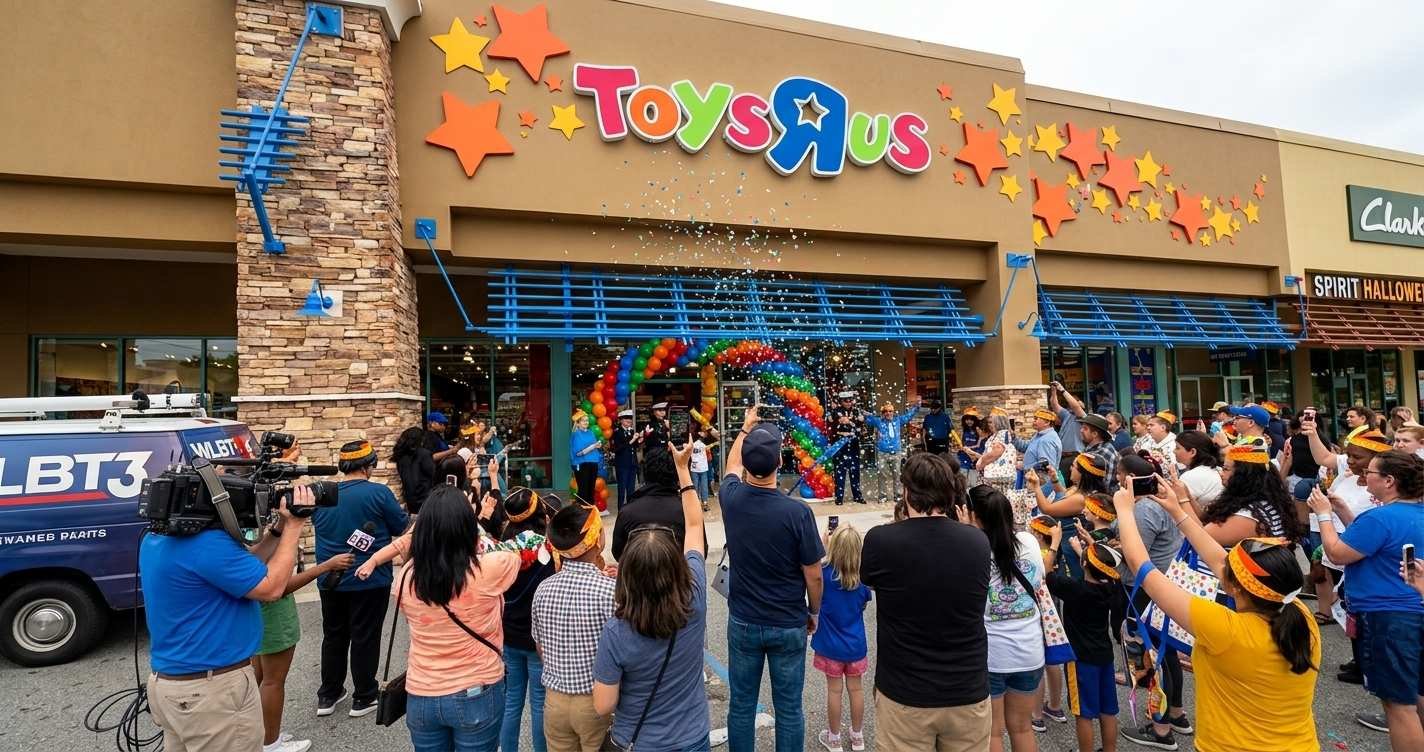
The 120 new stores are rolling out across the country as part of a nationwide push, rather than being concentrated in just one region. Recent grand openings, including one in San Marcos, Texas, give a sense of the format: mid-size standalone stores located in shopping centers and retail corridors that put Toys R Us back in front of everyday foot traffic, rather than tucked away as a small shop-in-shop.
Local coverage in various markets has highlighted specific openings as part of this wave, including new locations at outlet centers and shopping districts across multiple states. Beyond traditional retail corridors, the expansion also includes new formats entirely: Toys R Us is adding an airport shop-in-shop at Orlando International Airport, continuing a travel-retail push that previously included a location at Dallas/Fort Worth International Airport, and the brand is also expanding into Navy Exchange (NEXCOM) locations, bringing Toys R Us to military families on base.
Beyond the 120 standalone stores, roughly 40 additional Toys R Us shops are also opening inside Macy’s locations ahead of the holiday season, adding to the roughly 40 standalone stores and hundreds of existing Macy’s shop-in-shops the brand already operates nationwide.
The Toys R Us Comeback Story: How the Brand Got Here
To understand why this expansion is generating so much attention, and so much nostalgia, it helps to look back at just how far Toys R Us has fallen and climbed back since its heyday as the dominant name in American toy retail.
Toys R Us was founded in 1948 by Charles Lazarus, who started the business as a baby-furniture retailer in Washington, D.C. before pivoting toward toys and growing the chain into a category-defining retail giant over the following decades, complete with its beloved Geoffrey the Giraffe mascot and the jingle that generations of American kids grew up singing.
The chain’s decline came from a mix of factors: a heavy debt load left over from a 2005 leveraged buyout by private equity firms, combined with growing competition from big-box mass merchants and online retailers like Amazon. In January 2017, before the fall, the company still operated more than 1,600 stores and licensed hundreds more across dozens of countries. But later that year, Toys R Us filed for Chapter 11 bankruptcy protection. Unable to restructure its way out, the company was pushed into full liquidation, closing all of its roughly 900 remaining U.S. stores and laying off approximately 33,000 employees. By January 2021, the brand’s last two U.S. physical locations had shut their doors for good.
The Revival: WHP Global Takes Over
The brand’s path back began in March 2021, when brand management firm WHP Global announced it was taking a controlling stake in Tru Kids Inc., the entity that had acquired the Toys R Us and Babies R Us intellectual property out of the bankruptcy. WHP Global, backed by a $350 million equity commitment from funds managed by Oaktree Capital Management, is a company built around reviving and managing consumer brands, and its portfolio also includes names like Anne Klein, Joseph Abboud, and Vera Wang.
WHP Global chairman and CEO Yehuda Shmidman described Toys R Us at the time as the single most credible, trusted, and beloved toy brand in the world, and said the U.S. represented a blank canvas for rebuilding it. The comeback started small: two pop-up stores had already closed early due to the pandemic, so WHP’s real first major move came in summer 2021, when it announced a plan to open more than 400 mini Toys R Us shops inside Macy’s stores nationwide, giving the brand instant, wide-reaching physical distribution without the overhead of running hundreds of standalone leases.
From there, the brand slowly rebuilt its own standalone presence too. A 20,000-square-foot flagship store opened at the American Dream mega-mall in New Jersey in 2021, followed by a second flagship inside the Mall of America in Bloomington, Minnesota, in November 2023. WHP later expanded into what it called an “Air, Land and Sea” strategy, adding airport shop-in-shops (starting with Dallas/Fort Worth International Airport) and even cruise ship retail partnerships, continuing to diversify how and where shoppers could encounter the brand.
By the time of this latest 120-store announcement, WHP said it had grown Toys R Us’s global footprint by more than 50% since acquiring the brand, with upward of 1,400 stores and e-commerce sites operating across 31 countries worldwide, a remarkable turnaround for a company that, just a few years earlier, had zero physical stores left in the United States.
Why This Expansion Is a Bigger Deal Than It Might Seem
It would be easy to file this away as just another retail expansion story, but for anyone who grew up with Toys R Us, this particular announcement carries an outsized emotional weight. The brand’s 2017-2018 collapse wasn’t just a business story, it became a genuine cultural moment, with adults across the country sharing memories of childhood trips down the aisles, the jingle, and Geoffrey the Giraffe, as the last stores shuttered their doors.
Bringing back 120 real, physical, standalone stores in a single holiday season is a meaningfully different scale of comeback than the shop-in-shop model the brand leaned on for its first few years back. It signals that WHP Global believes there’s now enough proven, sustained demand, evidenced by those seasonal pop-ups that ended up staying open year-round, to justify a much bigger, more permanent physical retail bet. For the broader toy industry, which has faced its own struggles from shifting retail habits and competition from online and mass-market sellers, a large-scale, dedicated toy retailer expanding this aggressively is being read as a meaningful vote of confidence in the category as a whole.
Timeline: The Full Toys R Us Comeback, Step by Step
To fully appreciate how big a moment this 120-store announcement really is, it helps to see the entire arc of the brand’s collapse and rebuild laid out chronologically:
- 1948 – Charles Lazarus founds the business as a baby-furniture retailer in Washington, D.C., later pivoting to toys and building it into a category-defining national chain.
- 2005 – Toys R Us is taken private in a leveraged buyout by private equity firms, loading the company with debt that would haunt it for over a decade.
- September 2017 – Toys R Us files for Chapter 11 bankruptcy protection, unable to manage its debt load amid rising competition from mass merchants and online retailers.
- 2018 – Unable to restructure, the company is pushed into full liquidation, closing all roughly 900 remaining U.S. stores and laying off around 33,000 employees.
- January 2021 – The brand’s final two U.S. physical locations, opened as a limited pandemic-era test, close for good.
- March 2021 – WHP Global announces it is taking a controlling stake in Tru Kids Inc., the entity holding the Toys R Us intellectual property, kicking off the brand’s formal revival.
- 2021 – A 20,000-square-foot flagship store opens at the American Dream mega-mall in New Jersey, and WHP announces plans for more than 400 Toys R Us shop-in-shops inside Macy’s stores nationwide.
- 2022 – The Macy’s shop-in-shop rollout begins in earnest, giving Toys R Us instant, wide physical distribution across the country.
- November 2023 – A second flagship store opens inside the Mall of America in Bloomington, Minnesota.
- 2024-2025 – WHP expands its “Air, Land and Sea” strategy, adding airport shop-in-shops starting with Dallas/Fort Worth International Airport and exploring cruise ship retail, alongside a steady drip of new standalone and outlet-mall locations across multiple states.
- September 2026 – Toys R Us announces its largest U.S. expansion yet: 120 new standalone stores opening this holiday season, bringing the standalone footprint to 160 locations, alongside new Orlando airport and Navy Exchange locations.
Viewed as a full timeline, this latest announcement isn’t a sudden pivot, it’s the natural next step in a patient, multi-year rebuild that started with a single flagship store and a few hundred small Macy’s shops and has steadily scaled up ever since.
How Toys R Us Fits Into the Broader Toy Industry Right Now
This expansion doesn’t happen in a vacuum. The broader toy industry has spent the past several years adjusting to major shifts in how people shop, with mass merchants like Walmart and Target, along with online giants like Amazon, dominating toy sales through sheer scale and convenience. Dedicated, toy-only retail chains have struggled to compete on price and selection against that kind of scale, which was part of what doomed the original Toys R Us in the first place.
What’s different about this new version of Toys R Us is that it isn’t trying to out-discount Walmart or out-select Amazon. Instead, the strategy leans heavily on experience, brand nostalgia, and in-person discovery, things like Creator Studios, candy shops, cafes, and a curated (rather than exhaustive) selection of the season’s hottest items. That’s a deliberate bet that shoppers, especially parents and gift-givers during the holiday season, still value a dedicated, fun, in-person destination for toy shopping, even in an era dominated by e-commerce and big-box convenience.
Toy sales themselves have also shown resilience in recent years, with pandemic-era demand spikes giving way to a more normalized but still substantial market, driven by evergreen brands like LEGO, Barbie, and Hot Wheels alongside newer entertainment-driven properties. A dedicated toy retailer expanding this aggressively suggests real confidence that there’s still a meaningful audience for a store built entirely around play, rather than toys being just one aisle among many in a larger big-box store. Industry watchers will likely be paying close attention to how these new locations perform through the holiday shopping season and into the new year, since a strong showing could encourage further standalone expansion, while a weaker result might push the brand back toward leaning more heavily on partnership formats like the Macy’s shop-in-shop model that carried it through the early years of its comeback.
The Role of Geoffrey the Giraffe and Brand Nostalgia
Part of what makes this expansion resonate so strongly beyond typical retail-industry coverage is the sheer strength of Toys R Us as a piece of American pop culture. Geoffrey the Giraffe, the brand’s longtime mascot, and the company’s famous jingle, promising kids they “don’t want to grow up” because they’re a Toys R Us kid, are cultural touchstones for multiple generations of American children, now adults who are themselves buying holiday gifts for their own kids or grandkids.
WHP Global has leaned into that nostalgia deliberately throughout the brand’s revival, keeping Geoffrey front and center in store branding and marketing rather than attempting a full rebrand. That decision reflects a broader truth about why this expansion is landing as such big news: Toys R Us isn’t just another toy retailer opening more locations, it’s a beloved, culturally significant brand that many people assumed was gone for good, making its return to physical retail at this scale feel more like a genuine comeback story than a routine business expansion. That emotional pull is also likely a big part of why the plain word “toy” spiked so sharply in search interest rather than a more specific phrase, since so many people encountering the headline are reacting less to retail-industry logistics and more to a genuine wave of childhood nostalgia.
How This Expansion Compares to the Brand’s Earlier Comeback Attempts
It’s worth noting that this isn’t Toys R Us’s first attempt at a physical comeback since the 2017 bankruptcy, and understanding how this expansion differs from earlier efforts helps explain why it’s being treated as such a significant milestone.
Tru Kids, the entity that first acquired the Toys R Us intellectual property out of bankruptcy, actually attempted two pop-up store openings in 2019, well before WHP Global’s involvement. Both of those early locations ended up closing due to the crippling effects of the COVID-19 pandemic on retail foot traffic, a reminder that a brand name alone wasn’t enough to guarantee a successful physical return without the right backing, partners, and timing.
WHP Global’s approach, by contrast, has been notably more patient and methodical: start with a low-risk, high-distribution shop-in-shop model inside an established retail partner like Macy’s, prove out demand with a couple of high-profile flagship stores, gradually test new formats like airports and cruise ships, and only then commit to a large-scale standalone store rollout once the underlying demand signals, like those extended seasonal leases, made the bet look safe. That more gradual, evidence-based expansion strategy is a big part of why this 120-store rollout is being treated as a credible, sustainable growth story rather than another overreach that risks repeating the mistakes of the brand’s pre-bankruptcy era, when rapid, debt-fueled growth ultimately left the original company unable to survive a genuinely tough retail environment.
What This Means for Shoppers and Parents This Holiday Season
If you’re a parent, grandparent, or gift-giver planning ahead for the holidays, here’s the practical takeaway from all of this:
- More in-person options are coming. With 120 new standalone stores plus additional Macy’s shops opening before the holidays, significantly more shoppers will have a dedicated toy store within reasonable driving distance than in recent years.
- Expect a mix of classic and trending brands. The new stores are being stocked with a curated assortment spanning long-running favorites like LEGO, Barbie, and Hot Wheels alongside currently trending properties like Pokemon and KPop Demon Hunters merchandise, so both nostalgic classics and this year’s must-have items should be represented.
- Some locations offer more than just shopping. If a Creator Studio, candy shop, or cafe location opens near you, it may be worth treating a toy-shopping trip as more of an outing or event, rather than a quick in-and-out errand.
- Check locally for exact opening dates. Because the rollout spans the entire country and multiple store formats, the best way to confirm whether, and when, a location is opening near you is to check local news coverage or the company’s official store locator as the holiday season approaches.
- Traveling families have new options too. With airport shop-in-shops expanding to locations like Orlando International Airport, travelers passing through on the way to or from a trip may now be able to pick up a last-minute gift without leaving the terminal.
The Bottom Line
Strip away the nostalgia and the headlines, and the core fact driving this story is straightforward: a brand that completely disappeared from American strip malls and shopping centers just a few years ago is now opening 120 new physical stores in a single holiday season, a scale of comeback that would have seemed almost unthinkable back when the last U.S. Toys R Us locations shut their doors in early 2021.
Whether this proves to be the true full-scale revival of Toys R Us as a dominant physical retailer, or simply a well-executed, experience-driven niche play alongside the mass merchants and online giants that now dominate toy sales, this expansion is by any measure the clearest signal yet that the brand’s comeback has real momentum behind it. For millions of shoppers who grew up singing the jingle and wandering the aisles as kids, that alone is enough to explain why a single word, “toy”, is suddenly one of the fastest-rising searches on Google, and why so many people are eager to know exactly when a new store might be opening near them this holiday season.
A Look at Local Openings
Because this expansion touches dozens of markets at once, local news coverage has been rolling out store-by-store as openings are confirmed. In Mississippi, for example, local outlets reported Toys R Us as one of several major retailers opening at the Outlets of Mississippi shopping center, part of the same nationwide wave. Similar local stories are expected to keep surfacing market by market as the full list of 120 locations opens through the rest of the year, so shoppers curious about a store near them should watch local retail and business news, or the company’s own store locator, for confirmation of exact addresses and opening dates in their area.
Frequently Asked Questions About the Toys R Us Expansion
How many new Toys R Us stores are opening?
Toys R Us is opening 120 new standalone stores across the U.S. this holiday season, bringing its total standalone U.S. store count to 160.
Who owns Toys R Us now?
Toys R Us is owned by WHP Global, a brand management firm that acquired a controlling stake in the brand’s parent company, Tru Kids, in March 2021, after the original company’s 2017-2018 bankruptcy and liquidation.
Who is Toys R Us partnering with for this expansion?
The new stores are opening in partnership with Go! Retail Group, an Austin, Texas-based company that specializes in operating pop-up and seasonal retail experiences and has been a key partner in the Toys R Us comeback for several years.
What are Creator Studios?
Creator Studios are dedicated in-store spaces, launching in select locations, where influencers and toy brands can film content, host product reveals, and run launch events directly inside a Toys R Us store.
Will the new stores be open year-round or just for the holidays?
While the rollout is timed for the holiday season, the company expects many of the new stores to remain open year-round, based on past experience where seasonal pop-ups performed well enough to have their leases extended into permanent stores.
Does Toys R Us still have stores inside Macy’s?
Yes. Toys R Us operates shop-in-shops inside hundreds of Macy’s locations nationwide, a model that began in 2022, and roughly 40 additional Macy’s-based shops are opening ahead of this holiday season alongside the 120 standalone stores.
Is Toys R Us also opening airport and military stores?
Yes. The brand is expanding its travel retail presence with a new shop-in-shop at Orlando International Airport, adding to an earlier location at Dallas/Fort Worth International Airport, and is also expanding into Navy Exchange (NEXCOM) locations serving military families.
When did Toys R Us go bankrupt, and why?
Toys R Us filed for Chapter 11 bankruptcy in September 2017, weighed down by debt from a 2005 leveraged buyout and rising competition from big-box and online retailers. It was unable to restructure and was pushed into liquidation, closing all U.S. stores by early 2021.
Has Toys R Us tried a comeback before this?
Yes. Tru Kids attempted two pop-up stores in 2019 that later closed due to the pandemic, and WHP Global’s revival since 2021 has gradually expanded from Macy’s shop-in-shops to flagship stores, airport locations, and now this large-scale standalone rollout.
Is Geoffrey the Giraffe still the Toys R Us mascot?
Yes. WHP Global has kept Geoffrey the Giraffe central to the brand’s identity throughout its revival, leaning into the nostalgia that made Toys R Us a household name for generations of American families.
Key Takeaways
- Toys R Us is opening 120 new standalone U.S. stores this holiday season, its biggest expansion in years, bringing its standalone footprint to 160 locations.
- The rollout is happening through a partnership with Go! Retail Group and includes new features like Creator Studios, candy shops, and cafes at select locations.
- The expansion also touches airports, with a new Orlando International Airport shop, and Navy Exchange military locations.
- This builds on a comeback that began in 2021, when WHP Global acquired the brand after its 2017 bankruptcy and started with hundreds of shop-in-shops inside Macy’s.
- Many of the new stores are expected to stay open year-round, based on strong performance from earlier seasonal locations.
- The scale of this expansion marks a genuine milestone in Toys R Us’s slow, multi-year rebuild back into a real physical retail presence across the U.S.