
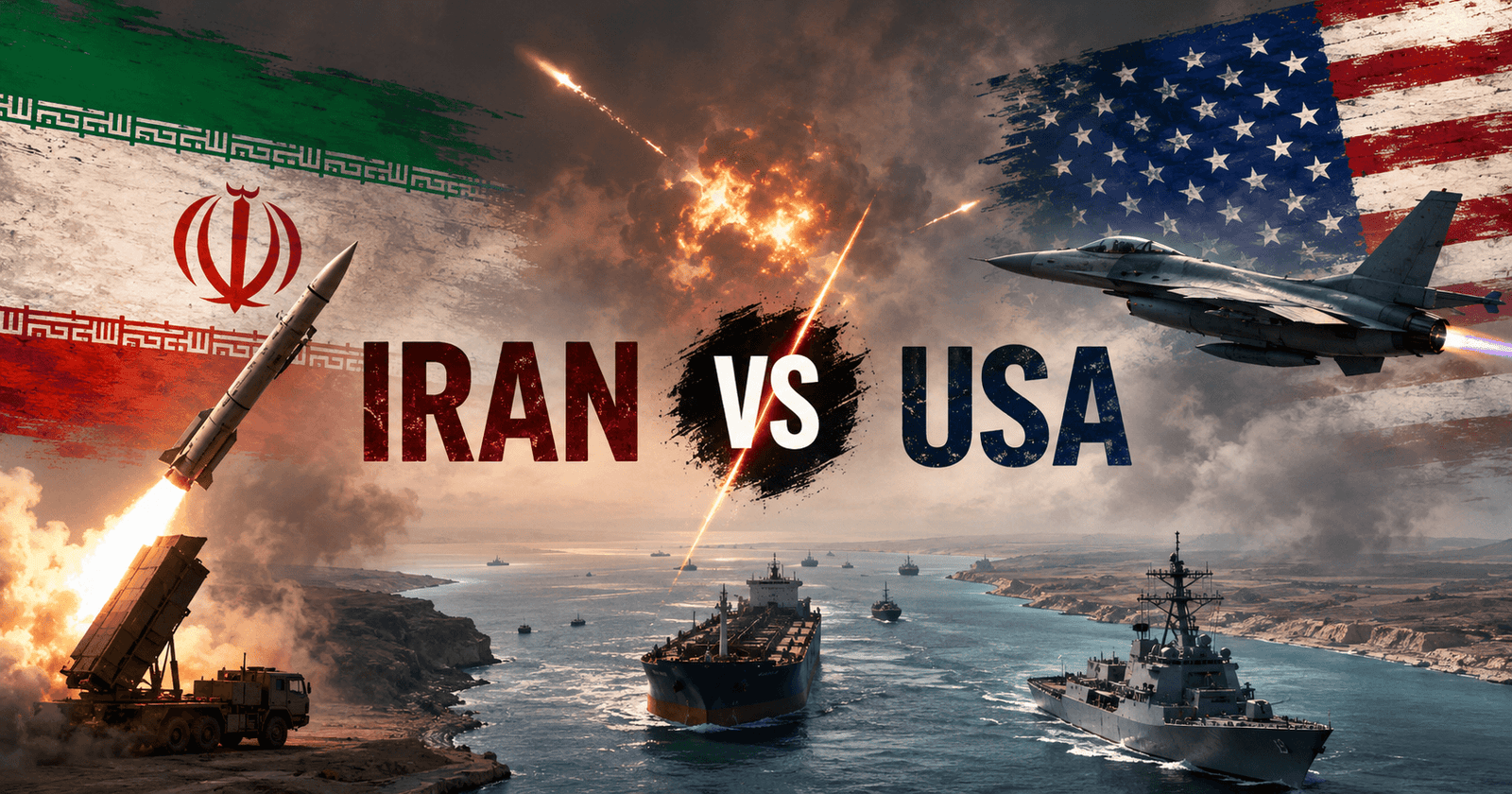

Washington says the strikes hit Revolutionary Guard positions after attempted attacks on shipping and US troops, while Tehran claims civilian casualties in return fire.
The United States and Iran exchanged fresh military strikes this week, sharply raising the risk of a wider war in the Gulf region. US Central Command (CENTCOM) said American forces struck Islamic Revolutionary Guard Corps (IRGC) targets in Iran, while Tehran said it launched retaliatory strikes on US-linked interests, reporting a number of civilian deaths in the process.
The exchange is the latest flashpoint in a months-long standoff over the Strait of Hormuz, a narrow waterway that carries roughly a quarter of the world’s seaborne oil trade.
WHAT HAPPENED?
According to CENTCOM, US forces began striking IRGC targets in Iran after what the command described as attempted Iranian attacks on commercial shipping in the Strait of Hormuz and on American service members stationed in the region. The strikes followed an earlier American operation against rocket launchers on Iran’s Larak Island, after CENTCOM said Iranian forces appeared to be preparing to fire rockets carrying sea mines into the strait.
Iran responded by launching missiles toward US positions in Jordan, which were intercepted, and the United Arab Emirates said it intercepted an Iranian drone over its territorial waters. Iranian state media later reported that a US strike had hit a village wedding celebration near the strait, killing several people including a child, and that separate strikes in Khuzestan province killed several more. US military officials said they were aware of the Iranian claims but denied deliberately targeting civilians.
Two commercial tankers were also struck by projectiles in the days following the initial exchange, according to maritime monitoring groups.
WHAT OFFICIALS / SOURCES ARE SAYING
CENTCOM said the operation was a “limited, precise action” against IRGC forces attempting to threaten shipping lanes. President Donald Trump confirmed the strikes on social media, describing them as “large and powerful” and warning of a much harsher response if Iran retaliated again.
An Iranian military source quoted by the IRGC-linked Tasnim News Agency said Tehran’s response would be “several times greater” than the American strikes. The United Nations Secretary-General’s spokesperson said Secretary-General António Guterres was “gravely concerned” by the exchange of fire and alarmed by reports of civilian casualties.
KEY FACTS
- Location: Strait of Hormuz and surrounding Iranian territory, including Khuzestan province
- Date: Strikes began around midday US Eastern Time this week, with retaliation continuing over the following days
- Casualties: Iran claims multiple civilian deaths, including from a strike near a wedding celebration; the US disputes any deliberate targeting of civilians
- Official response: CENTCOM confirms strikes on IRGC targets; Trump warns of escalation; Iran vows a stronger retaliation
- Latest development: The US Embassy in Qatar has warned of possible flight cancellations and airspace disruptions amid fears of further escalation
WHY THIS MATTERS
The Strait of Hormuz is one of the world’s most important energy corridors, and any prolonged disruption threatens to push global oil prices higher, adding pressure to economies already dealing with inflation. The conflict also carries political weight in Washington, where it has become a flashpoint ahead of the November midterm elections. Regionally, an escalation risks drawing in other Gulf states and shipping nations whose vessels pass through the strait daily.
BACKGROUND
Tensions around the strait trace back to a broader 2026 conflict between the US, Israel and Iran that began earlier this year, after which Iran moved to restrict shipping through Hormuz. The US subsequently launched an aerial campaign and a naval blockade aimed at reopening the waterway, actions Iran has continued to resist. The current strikes represent one of several rounds of direct US-Iran military contact since that campaign began.
WHAT HAPPENS NEXT?
US officials have signaled that further “periodic” strikes may follow if Iran continues attempting to rebuild radar and missile capabilities near the strait. Diplomatic channels, including statements from the United Nations, suggest calls for de-escalation are likely in the coming days. Markets and shipping companies are expected to watch closely for signs of further disruption to tanker traffic.
LATEST UPDATE
As of this report, both sides continue to trade accusations, and the security situation around the Strait of Hormuz remains volatile. The situation is still developing, and further details are expected as officials on both sides issue updated statements.