
Berlin says an explosives-laden drone found near a Ukrainian cargo plane last month fits a known pattern of Russian hybrid operations, prompting the closure of a consulate and a cultural centre.
The German government said on Tuesday that it holds Russia responsible for an attempted drone attack at Leipzig/Halle airport last month, and announced a series of retaliatory measures. The assessment was presented jointly by Interior Minister Alexander Dobrindt and Foreign Minister Johann Wadephul at a press conference in Berlin.
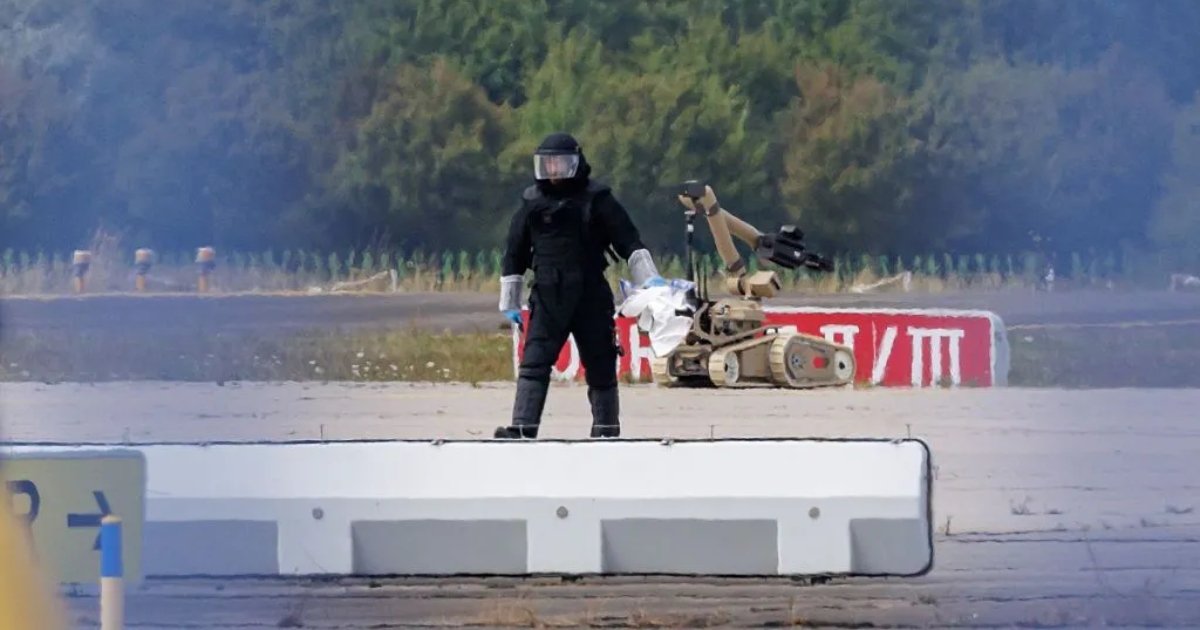
The incident took place on the night of August 4-5, when a drone carrying explosives was discovered near a Ukrainian cargo aircraft on the airport grounds. German authorities say the device failed to detonate, and a bomb-disposal robot was used to defuse it.
WHAT HAPPENED?
According to officials, the explosives-laden drone was found close to an Antonov cargo plane operated by Ukraine’s Antonov Airlines, which has been based at Leipzig/Halle since Russia destroyed the airline’s home base near Kyiv in the early days of its 2022 invasion.
A second drone was reportedly found around August 14 in a field in Kabelsketal, a municipality bordering the airport. German media, including Süddeutsche Zeitung and Der Spiegel, reported that this device carried traces of a military-grade explosive and, like the first, appeared to be defective. Some reports also point to a possible third drone discovered in a nearby field roughly a week after the initial incident, though details on this device remain limited.
Investigators have also raised the possibility that a separate drone may have collided with a cargo aircraft near the airport, though it has not been confirmed whether the plane sustained any damage.
Germany’s Federal Prosecutor’s Office is handling the investigation and has declined to comment publicly, citing the case’s ongoing status.
WHAT OFFICIALS / SOURCES ARE SAYING
Interior Minister Alexander Dobrindt said the assessment of the incident matches an established pattern of Russian hybrid operations in Europe. He added that Germany expects to remain a target of further such actions.
Foreign Minister Johann Wadephul announced that the Russian consulate in Bonn will close from September 18, and that the operating contract for the Russian House, a Kremlin-linked cultural centre in Berlin, will be terminated.
Chancellor Friedrich Merz, who was not present at Tuesday’s briefing, has previously said Germany has increasingly found itself targeted by unscrupulous hybrid attackers, and warned in late August that those responsible would face consequences.
The Kremlin has consistently denied involvement in hybrid attacks attributed to it across Europe, and Russian officials were not immediately available for comment on Tuesday’s announcement.
KEY FACTS
- Location: Leipzig/Halle airport, eastern Germany, roughly 170 km south of Berlin
- Date of incident: Night of August 4-5, 2026
- What was found: A drone carrying explosives near a Ukrainian cargo aircraft; a second drone with explosive traces found nearby around August 14
- German response: Closure of the Russian consulate in Bonn from September 18; termination of the Russian House cultural centre’s operating contract in Berlin
- Officials involved: Interior Minister Alexander Dobrindt, Foreign Minister Johann Wadephul
- Investigation status: Ongoing, led by the Federal Prosecutor’s Office
WHY THIS MATTERS
Leipzig/Halle is one of Europe’s busiest cargo airports and has served as the operational base for Ukraine’s Antonov Airlines since 2022, making it a logistically significant site for support flowing to Kyiv. An attack there would represent a direct challenge to that supply chain.
The episode also lands amid a broader pattern of suspected Russian hybrid activity across Europe this year, including drone sightings over airports and infrastructure in multiple countries. Germany is NATO’s most populous member and one of Ukraine’s largest military donors, so an escalation in hybrid pressure against it carries implications for the alliance’s collective security posture.
There is also a domestic political dimension: the drone incidents come ahead of regional elections in eastern German states this month, where the far-right, Russia-friendly Alternative for Germany (AfD) party is expected to perform strongly.
BACKGROUND
Germany has for months reported suspicious drone sightings near military and industrial sites, part of a wider wave of incidents across the continent. Similar sightings have disrupted airports in Munich and Frankfurt, as well as in countries including Denmark, Lithuania, Finland, Estonia, Romania, Belgium and the Netherlands.
Western intelligence services have repeatedly linked Russia to a range of seemingly unconnected security incidents in Europe, including arson, cyberattacks, GPS jamming and sabotage of undersea cables, though Moscow has rejected these accusations. Until now, Berlin had spoken more cautiously of possible involvement by “foreign powers” without naming Russia directly.
WHAT HAPPENS NEXT?
The Federal Prosecutor’s Office investigation into the Leipzig incident remains ongoing, and further findings are expected as it continues. The closure of the Russian consulate in Bonn is set to take effect on September 18.
Germany’s regional elections in the eastern states are approaching this month, and the drone episode is likely to feature in the political debate surrounding them. U.S. intelligence assessments cited separately suggest Russia could test NATO’s resolve with a limited attack on an allied country in the coming years, a factor likely to keep hybrid-threat concerns high on the agenda in Berlin and Brussels.
LATEST UPDATE
As of Tuesday, September 1, German officials have formally attributed the Leipzig/Halle drone incident to Russia and set diplomatic measures in motion. The investigation remains active, and further details are expected as authorities continue their inquiry.