

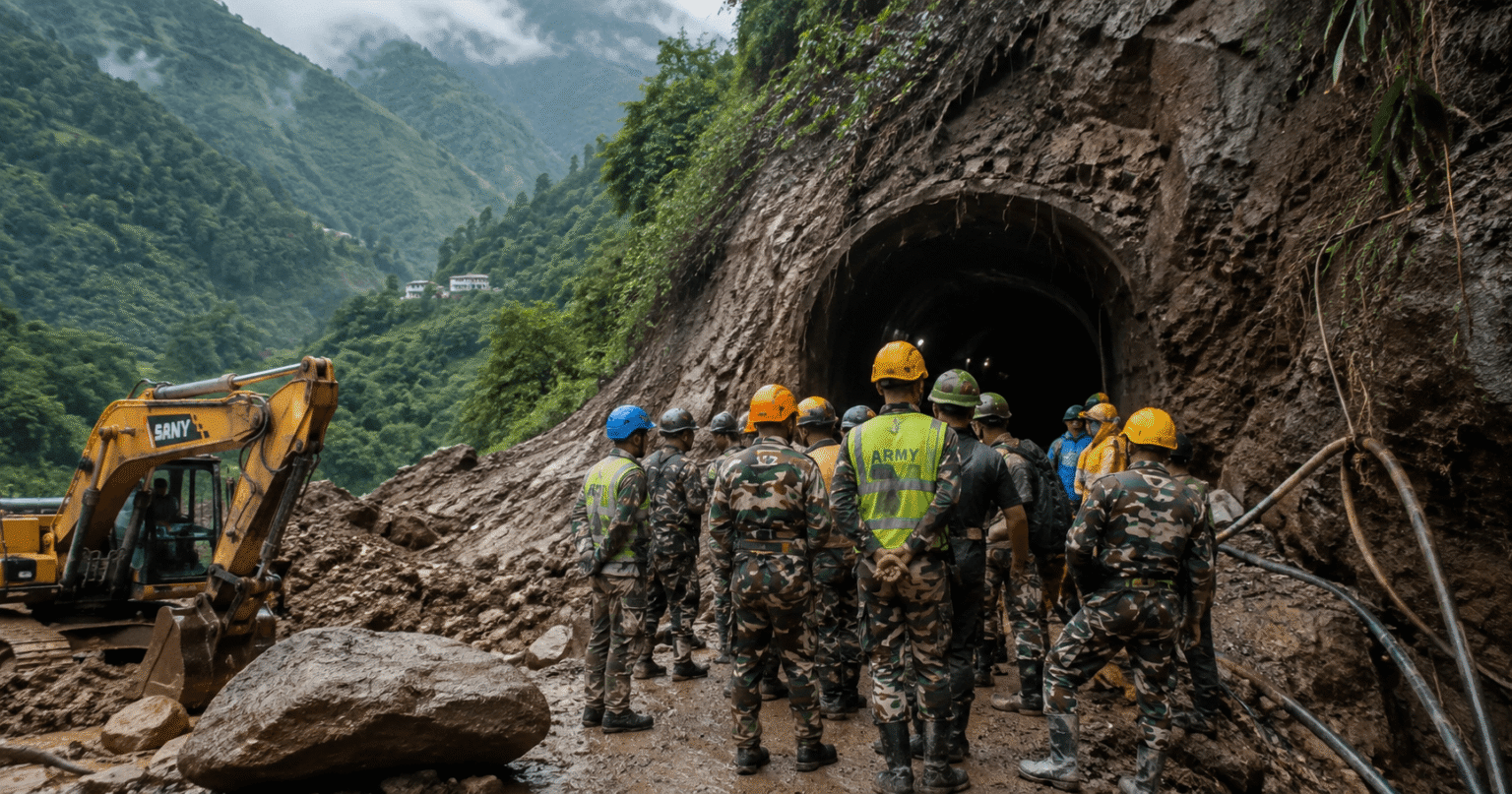

Army teams are blasting into a mud-covered hillside along the Trishuli River as families of more than 600 missing hydropower workers hold on to hope of a rescue.
Rescue teams in Nepal are using controlled explosives to cut through a hillside buried in mud, racing to reach hundreds of hydropower workers who have been trapped since last week’s catastrophic flooding along the Trishuli River. Families of the missing say they are still holding on to hope, even as officials warn that the window to find survivors alive is narrowing.
The push comes as Nepal’s disaster management authority confirmed the nationwide death toll from the flooding has climbed to 939, with thousands more still unaccounted for.
WHAT HAPPENED?
Relatives of more than 600 workers believed to be buried inside a network of mud-choked tunnels along the Trishuli River are anxiously waiting for news, as army personnel continue blasting into the hillside and pumping air into the affected Trishuli-3A site.
Rescue crews began pumping air into one tunnel over the weekend, though families have said this step should have come sooner. On Monday, a rescue team managed to enter a tunnel leading to one of the hydropower plants but withdrew after finding no one inside.
The disaster originated from flooding along the Nepal-Tibet border, which sent water, mud and debris crashing down the mountainside and burying several hydropower facilities built along the river system. According to Nepal’s disaster management authority, at least 11 hydropower projects — either completed or still under construction — were damaged.
WHAT OFFICIALS / SOURCES ARE SAYING
Nepalese Prime Minister Balendra Shah said on Monday that 279 people had been rescued from the affected hydropower sites, and that the overall rescue effort — which now totals 11,379 people rescued since the disaster began — had been stepped up.
The search operation is being led by a joint Chinese-Nepalese military team, with additional support from specialists from India, South Korea and Australia.
Arnold Dix, an Australian engineer and former head of the International Tunnelling Association who has been assisting Nepalese authorities remotely, said the landscape around the buried plants has been so transformed by the disaster that rescuers have struggled simply to locate the tunnel entrances, comparing the terrain to a “lunar landscape.” He added that once crews identify a power station’s location, the process typically involves digging and blasting through massive boulders — some larger than houses.
Family members of the missing, including relatives who spoke with BBC Nepali and the Nepalese daily Kantipur, described a mix of hope and mounting frustration with the pace of the search, with one relative saying the operation needed to move faster because “every second is meaningful.”
KEY FACTS
- Location: Hydropower project sites along the Trishuli River, Nepal, including Trishuli-3A, Chilime and Upper Trishuli-1
- Confirmed deaths nationwide: 939, according to Nepal’s disaster management authority
- People still missing: Estimated at 3,925, including 592 foreign nationals
- Workers trapped at hydropower sites: More than 600 believed trapped, or roughly one in seven of all those missing
- Rescued so far: 279 people from hydropower sites; 11,379 people rescued overall since the disaster began
- Rescue teams involved: Chinese and Nepalese military personnel, with specialists from India, South Korea and Australia
- Damaged hydropower projects: At least 11 completed or under-construction sites affected
WHY THIS MATTERS
The scale of the disaster highlights Nepal’s heavy reliance on hydropower, an industry the country has spent years developing along its mountainous river systems to meet domestic energy needs and export electricity. The damage to at least 11 projects raises questions about the safety of facilities built in flood-prone Himalayan terrain and could affect Nepal’s energy output in the months ahead.
The human toll is also significant given how many of the missing are hydropower employees — a mix of local labourers, migrant workers and engineers — meaning the disaster has struck deeply at the workforce behind one of Nepal’s key industries.
BACKGROUND
The disaster stems from catastrophic flooding along the Nepal-Tibet border that swept debris, mud and water down the Bhote Koshi and Trishuli river valleys, overwhelming hydropower facilities built along the route. Downstream, in Nepal’s Chitwan district, the flooding has carried a large number of bodies far from where the disaster originated, forcing authorities to resort to temporary burial of unidentified remains while DNA testing is carried out to identify victims.
Across the border in Tibet, Chinese state media have reported 16 confirmed deaths and 546 people missing, though independent reporting on the scale of the disaster there has reportedly been restricted, and Chinese authorities have taken action against people questioned the officially reported casualty figures online. Nepalese authorities have likewise ordered the removal of online content they consider to be misinformation about the floods.
WHAT HAPPENS NEXT?
Rescue operations are expected to continue at the hydropower sites as crews work to locate remaining tunnel entrances and clear debris. Authorities are also expected to continue DNA identification work on unidentified remains recovered in Chitwan, a process officials say is being complicated by a shortage of storage facilities.
Officials have indicated that search efforts will keep intensifying, though the timeline for locating any remaining survivors remains uncertain given the extent of the terrain damage.
LATEST UPDATE
As of Monday, rescue teams remained engaged in an active search at the Trishuli-3A site and other affected hydropower locations, with the death toll and missing-persons figures still subject to revision. The situation remains ongoing, and further details are expected as officials continue the search-and-rescue operation.